
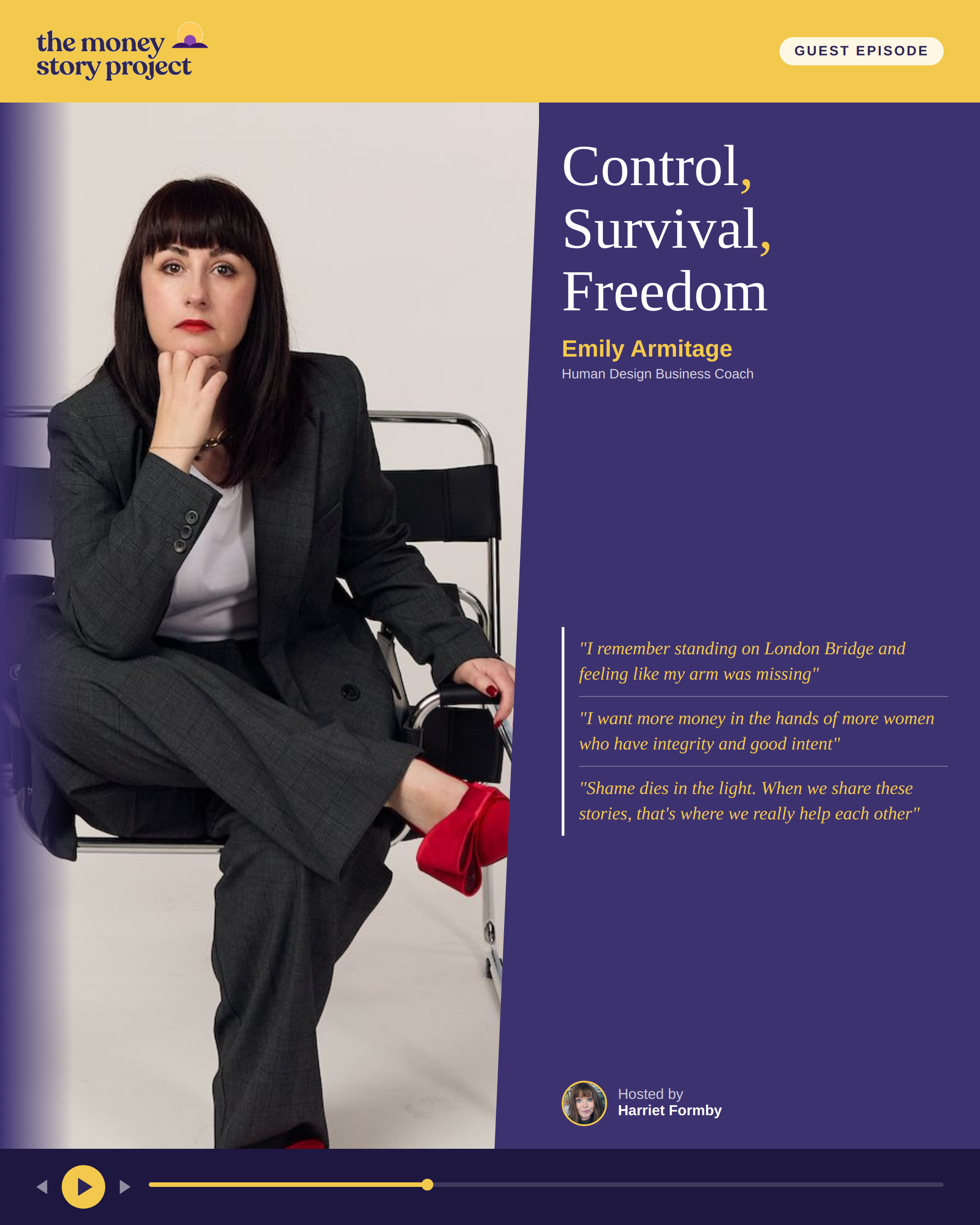
Control, Survival, Freedom with Emily Armitage
%20copy%2021.png)
People don’t expect someone like Emily to have been in this situation. That’s exactly why she’s sharing it — because it can happen to anybody, and shame only survives in silence.
⚠️ Content warning: This article discusses coercive control and financial abuse. Support details are at the end of the article.
“I remember standing on London Bridge and feeling like my arm was missing. Like it was as if a part of myself was not there.”
That’s Emily Armitage, describing what freedom felt like after leaving a relationship defined by coercive control. Not relief. Not celebration. Just this strange, disorienting sense that something fundamental had been taken.
Emily is a CEO, founder of The Yorkshire Zen Company, and a Human Design business coach and strategist for six-figure female founders. She’s articulate, successful, and driven. She’s also someone who, when she was younger, spent several years in a relationship she didn’t have the language for at the time — but now recognises as coercive and controlling. And money was right at the centre of it.
The money blueprint
Emily’s story doesn’t start with her relationship. It starts earlier.
Growing up in a working-class family where her parents had worked hard to build a comfortable life, but where money still carried a constant undercurrent of stress. There was always enough. But it never felt that way. Her mum was very much in control of the household finances — a dynamic Emily later recognised she’d unconsciously carried into her own relationships.
As a child, Emily made a little jobs list — still pinned up in her parents’ kitchen — charging her family pennies for hoovering, with a premium rate for taking her sister to the toilet. She laughs about it now, but the pattern was already there: money was something you had to earn, other people controlled it, and asking for it came with tension.
“I’ve always been quite aware of money and understanding that you worked for money and other people gave it to you, but that there was probably a lot of stress around it.”
“It was far more subtle than that”
When she was younger, Emily found herself in a relationship where financial control became a central feature. But it wasn’t the kind that’s easy to point at.
“People would be like, oh, you know, imagining he took my bank accounts away or withdrew my cards. And it wasn’t — it was far more subtle than that.”
From the outside, the relationship wouldn’t have raised alarm bells .That’s one of the things Emily is most keen to get across — coercive control doesn’t always look like what you’d expect. The surface can appear completely normal, even enviable, while the reality underneath is something else entirely.
At first, Emily was the one earning. She was young, she had a job, and she was financially supporting the relationship — bailing him out, paying for everything, dealing with his debts. Then the dynamic flipped. When he started earning more, money became a way of belittling and reducing her instead. She ended up financially dependent, with no financial power of her own.
“It’s the stuff that’s said, but it’s also the stuff that’s not said and that’s implied. That you then alter and shift your behaviours around. It’s what’s withheld, it’s what’s taken away. It’s what’s then thrown at you, and then you have to respond and react to it.”
What many people don’t realise about financial abuse is that it doesn’t always look one way. It can shift and adapt as circumstances change, but the underlying dynamic remains the same: one person using money as a tool of power over another.
Financial fawning
There’s something Emily and I talk about in this episode that I think deserves much more airtime: the concept of financial fawning.
Most people are familiar with fight, flight, and freeze as responses to danger. Fawning is the fourth — it’s where you appease the other person to keep yourself safe. You people-please, you go along with things, you make yourself agreeable, because resisting feels more dangerous than complying. Financial fawning is when that appeasement happens through money. You hand over money, pay the bills, bail them out, fund their lifestyle — not because you choose to, but because saying no has consequences. It’s people-pleasing through your wallet. And when your inner strength has been systematically dismantled, the energy required to resist just isn’t there.
“They are attracted to the power and brightness of you in the first place. And then they want to take it for their own and they want to use it. And they grind you down and grind you down and grind you down until there’s barely anything left of you. And then they abuse you for it.”
Emily puts it simply: the space she was in — even though it was horrible — felt safer than the alternative.
What’s particularly powerful about Emily’s reflection is her honesty about the role early conditioning played. She’s not blaming anyone. But she can see, with the benefit of significant distance, how the blueprint she’d absorbed growing up — that someone else is in charge of the money — made her more vulnerable to replaying that dynamic.
“I was sort of outsourcing the control to him. In a way, I let a lot of it happen because I was just replaying the dynamics that I’d been used to being part of.”
This is something I think anyone working with business owners and founders needs to understand. When someone has been through this kind of dynamic, the relationship with money doesn’t just reset when the relationship ends. The patterns — around earning, spending, saving, pricing, selling, being visible — are deeply embedded. They take years to unpick.
Freedom that doesn’t feel like freedom
Emily’s relationship ended a long time ago. But what followed was its own kind of upheaval — debts, damaged credit, and being financially tied to someone she was trying to leave behind. The process of disentangling, rebuilding independence, and the strange disorientation of having choices again.
“Having the freedom to do what I wanted and to go where I wanted and see who I wanted was overwhelming. Like I just didn’t know what to do with that.”
Her parents were there for her. She’s open about how fortunate and privileged she was to have that — not everyone does. They told her she’d always have a space at home, but they also encouraged her to build her independence, supporting her as she got a job and moved into a place of her own. The safety net was always there, but they helped her stand on her own feet.
But even with that support, she describes being overwhelmed by the simplest things — just having choices felt alien. That’s the reality of what coercive control does to someone’s nervous system and sense of self.
“It was only a combination of time and gradually doing what I wanted to do that helped me get back to some kind of level of normal.”
That period also became Emily’s gateway into self-development and nervous system work. She’s a naturally curious person, and the more space she got from the relationship, the more she was able to reflect on what had happened and understand it. That curiosity eventually led her to the work she does now.
Reclaiming autonomy through business
The rebuilding is where Emily’s work now lives. As a Human Design business coach, she helps women founders understand their own energetic blueprint — how they’re designed to work, to earn, to relate to money.
“I want more money in the hands of more women who have integrity and have good intent and want to use that money as the tool that it is.”
Emily talks about how entrepreneurship gave her back the autonomy she’d lost. The ability to decide what to charge, who to work with, when to show up. But she’s honest that it brought its own challenges — particularly around selling.
“There was a real manipulation I felt had to happen rather than a reciprocal, energetic exchange. I’ve had to do a lot of work around my relationship with selling.”
And visibility — after years of being made to feel small, putting herself out there required a whole different kind of healing.
“Being visible, being safe to be seen, when you’ve been told you’re boring or nobody’s interested in what you have to say and you’ve been belittled so much — that’s been a real learning curve.”
There’s a thread running through this entire conversation that I think is worth sitting with: the relationship between visibility and safety. When you’ve been controlled, being seen feels dangerous. And yet building a business — especially online — requires exactly that. It’s a tension many founders carry without necessarily understanding where it comes from.
Autism and coercive control
Emily was diagnosed as autistic recently, and it’s given her another lens through which to understand her experience. She’s not alone in that — research increasingly shows a significant link between autism and vulnerability to coercive and abusive relationships.
A 2023 meta-analysis found that 84% of autistic adults reported having been victimised in more than one category, with autistic women particularly affected. The reasons are complex: masking behaviours, difficulty reading others’ intentions, heightened people-pleasing, social isolation, and a deep desire for acceptance can all increase vulnerability. Late-diagnosed women are especially at risk, because they’ve often spent a lifetime adapting to dynamics they didn’t have the framework to question.
Autistic women also face compounding barriers — as both a gender and neuro-minority group, they’re less likely to be believed when they report abuse, and less likely to find support services that understand their needs.
This is an area that deserves far more attention and research. For further reading: Douglas & Sedgewick, 2023, Autism; the National Federation of Women’s Institutes’ 2024 briefing on neurodiversity and violence; and Somerset Domestic Abuse Service’s guide on neurodiversity and domestic abuse.
“This isn’t getting better”
Emily’s now at a point where she can share her story. She’s done the work, and the experience made her who she is. But she’s also clear about something else: this isn’t getting better.
“I see what young women are exposed to online and how they’re spoken to and the boys they’re in friendship groups with and how they speak to each other. And I’m like, oh my God. What was happening to me is now deemed as acceptable. How have we got in a position like this where how girls are spoken to is just so disgusting and they accept it.”
What Emily experienced as unusual — the control, the subtle manipulation, the erosion of self — she now sees normalised in the lives of younger women around her. The toxic masculinity influencer culture has made it harder, not easier, to spot the signs. The subtleties are more advanced. And young women are growing up thinking this is just how relationships work.
But there’s a flip side to that. Social media has also made us more savvy. We know now that what we see is a highlight reel. Years ago, if a relationship looked aspirational on the surface — the big life milestones, the outward success — people were far less likely to question what was going on behind it. Now there’s a much wider understanding that the surface doesn’t tell the whole story. And that shift in awareness matters.
Looking out for each other
Emily pointed out something important here: the onus of safety shouldn't be pushed back onto women who are experiencing coercive control or financial abuse. There should be bigger systemic change, but while that happens, we need to take care of each other as well. Our strength as women is in our community and the collective — the conversations we have with each other.
So what can we actually do?
Emily’s advice is practical. There is so much more support and information about coercive control out there now than there used to be — educate yourself, read about it, because knowledge is your power.
“Sharing my story will help people because people don’t expect me to have been in that situation. And it can happen to anybody.”
If you’re worried about someone, don’t give up on them. Emily is honest about that: when her parents raised concerns, she pushed back. When her friends did, it landed differently. She’s grateful for the friends who didn’t give up on her — even when she couldn’t hear what they were saying at the time.
There’s also something both Emily and I talk about that I think is worth sharing more widely: we can all be better at having open conversations about this. Normalising check-ins with people we care about. Creating a culture where it’s OK to say “something doesn’t feel right” without it being confrontational. The more we talk about coercive control openly, the easier it becomes to recognise — both in our own lives and in the lives of people around us.
Because coercive control is designed not to be obvious. It’s making someone question their own judgement. It’s isolating them from friends and family so gradually they don’t notice it happening. It’s creating a dynamic where the other person feels like everything is their fault. It’s financial decisions that look like shared choices but aren’t. It’s generosity that comes with strings. It’s behaviour that, from the outside, could be explained away — and that’s the point. The ambiguity is the tool.
Because the biggest risk with coercive control is that by the time the person in it realises what’s happening, they’re often already deep in it. The people around them might see it first. Looking out for each other is one of the most powerful things we can do.
The power of storytelling
Looking back now, Emily can see what she couldn’t at the time:
“If your body’s telling you something is off — it is off. And listen to it.”
But she’s also clear that this isn’t about blaming yourself for not seeing it sooner. Coercive control works precisely because it dismantles your ability to trust your own instincts. The message isn’t “you should have known” — it’s that if someone in your life is asking whether you’re OK, maybe listen to them. Because sometimes the people around you can see what you can’t.
“Shame dies in the light. When we share these stories, that’s where we really help each other.”
This was a brave and generous conversation. Emily’s willingness to connect her personal experience to the work she does now — and to the wider conversation about women, money, and power — is exactly why these stories matter.
Because sometimes the most important financial decision someone makes isn’t about spreadsheets or pricing strategies. It’s about reclaiming the right to have any say at all.
If anything in this episode has resonated with you, support is available. The National Domestic Abuse Helpline is free, confidential and available 24/7 on 0808 2000 247. For support specifically around financial abuse, contact Surviving Economic Abuse on 0808 196 8845. Full details and links are below.
Emily shares her personal experience and perspective of a past relationship. No allegations are made against any named individual. This conversation is shared in the public interest to raise awareness of financial abuse and coercive control.
About Emily Armitage
Emily is the CEO and founder of The Yorkshire Zen Company and a human design business coach and strategist for six-figure female founders. She uses Human Design as a powerful business lens — helping women entrepreneurs understand their energetic blueprint, tap into how they’re designed to work, sell, and relate to money, and build businesses that are sustainable and aligned rather than built on someone else’s formula. Emily is passionate about getting more money into the hands of women with integrity and good intent.
What’s coming up: THE ROOM — quarterly CEO day retreats for women who are ready to unapologetically claim £100k+ in 2026 and 2027. .
Connect with Emily: - Instagram: @emilyarmitage_ - LinkedIn: Emily Armitage - Website: emilyarmitage.co.uk
Resources
National Domestic Abuse Helpline: 0808 2000 247 (free, 24/7) nationaldahelpline.org.uk
Surviving Economic Abuse: 0808 196 8845 — survivingeconomicabuse.org
Women’s Aid: womensaid.org.uk
Victim Support: 08 08 16 89 111 — victimsupport.org.uk
Galop (LGBTQ+ support): 0800 999 5428 — galop.org.uk
National Autistic Society: autism.org.uk
Mums in Need: supporting mothers experiencing post separation abuse and coercive control - https://www.mumsinneed.com/
Men’s Advice Line: 0808 801 0327 — mensadviceline.org.uk
The Money Story Project
This conversation is part of The Money Story Project — a storytelling space where we explore what money means, what it's meant, and how we're all learning to carry it differently. If Gemma's story resonated, consider sharing it with someone who might need to hear it too. Connect with host, Harriet Formby.
Listen: Apple Podcasts Spotify
Find out more moneystoryproject.com
Be a guest complete form
More from the category:
Podcast
Sign up to the newsletter
Where the practical meets the visionary. Stories, tools and ideas about money, plus seasonal meanderings — straight to your inbox.