
Hustle, Guilt & Belonging - Raised Between Two Money Cultures - with Jaskiran Mangat
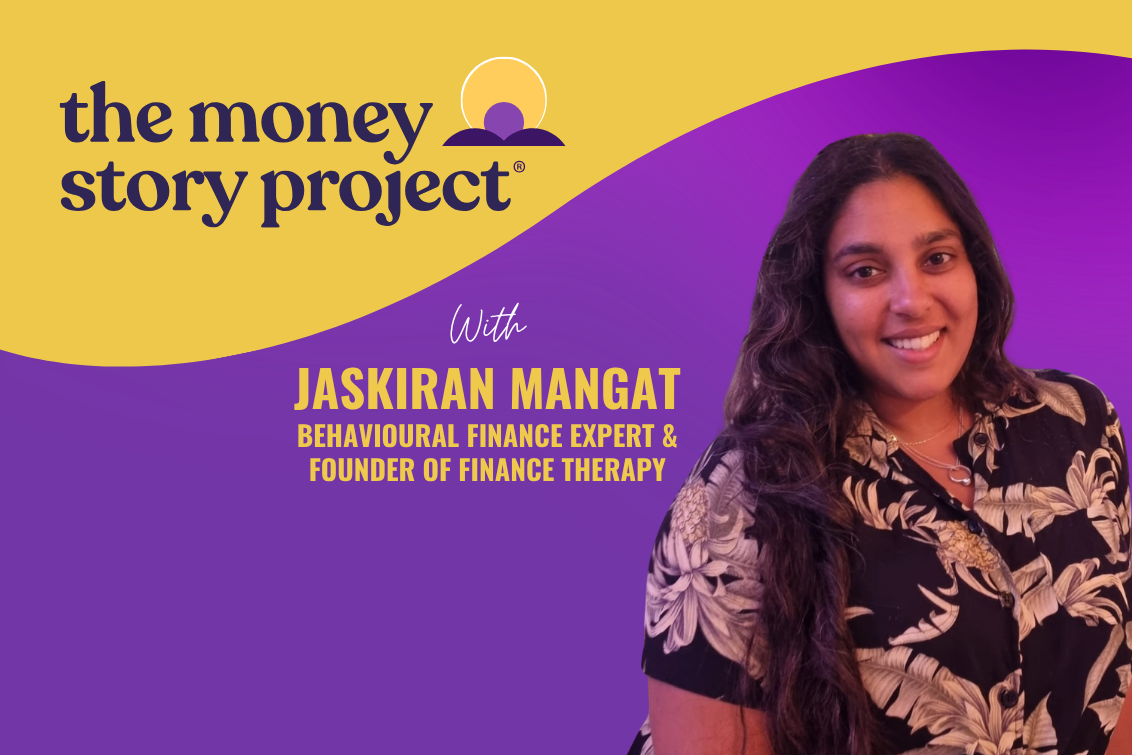
“My achievement probably also became tied to my self-worth.”
That’s Jaskiran Mangat — behavioural finance expert, speaker, writer, consultant, and founder of Finance Therapy — reflecting on the drive that’s shaped her whole career. She started out in banking before running a community of venture capital funds, working in a poverty charity as part of a social innovation fellowship, and eventually founding her own fintech to help marginalised communities build wealth.
The conversations in those spaces were always rational, always solutions-focused — trying to fix something. What was missing was the layer underneath: how emotional every single money decision actually is. That gap is what led her to build Finance Therapy, where she helps entrepreneurs, leaders and organisations make better financial and business decisions by understanding the psychology behind them.
Two money cultures
Jaskiran is a second-generation immigrant. Her grandparents came to the UK from villages in India in the 1950s and 60s. Her granddad had been a teacher there; here, he took on labouring work instead — work that wasn’t seen as professional in the same way. Inside the home, money came up constantly — security, sacrifice, saving. Outside it, nobody spoke about it at all.
“What happens in the home stays in the home.”
She started working the week she turned sixteen. It gave her an early, fierce sense of independence, but the values around saving ran deep enough that spending came with guilt attached. She was the first in her family to go to university. She didn’t get pocket money as a kid — it just wasn’t something in her house. Once she started earning her own, she found herself feeling like she shouldn’t ask her parents for money any more, taking on that responsibility even though nobody had actually asked her to.
Survival strategies, not wealth strategies
Immigrant families, Jaskiran says, often inherit survival strategies instead of wealth strategies. Frugality. The ability to value saving above almost everything else. Skills that are genuinely useful when you’re moving from the security of a salary into something as uncertain as entrepreneurship — but skills that don’t, on their own, teach you how to build wealth. She taught herself to invest. She’s spent the best part of the last fifteen years trying to convince her parents, her friends, people in her community, that investing is something they need to do too. It’s not something she grew up with, and it’s not something anyone around her grew up with either.
There’s a flip side to the values that shaped her, too. Things like living at home — she moved back in with her parents at thirty to give herself more runway to keep pursuing her entrepreneurial path, and in her community that’s not remotely shameful. In founder circles, it’s a different story: the rhetoric there says you should have moved out, that people won’t take you seriously if you’re still at home. And there’s the question of community itself. Immigrant families and communities tend to have community down to a fine art. The wider world she moved into — venture capital, start-ups — runs on individualism instead, and she’s noticed herself hesitating, more than once, before asking for something as small as a lift to the airport.
Ambition and belonging
Then came the guilt she didn’t expect: earning more than her parents.
“What do you mean I earn more than what they earn?”
There’s pride in that, and there’s distance too — achieving exactly what was expected of her, while her reality moved further and further from the people who raised her. Underneath it sits an unspoken pressure to take care of parents, sometimes younger siblings, to give back. It’s the kind of pressure that reroutes your own goals without you quite noticing, and makes success feel like it isn’t fully yours to enjoy.

Living between two worlds
Working in and around venture capitalists and bankers — people who’d often grown up inside that world — Jaskiran realised quickly that the values there weren’t the values she’d grown up with. More hours of life get spent at work than at home, and the further someone climbs, the less time is left for parents, grandparents, family. The advice she kept hearing was that she needed a mindset shift, that this was just how the world worked and she had to adapt to it. But underneath that is a harder question: how do you play by rules that were made by wealthy people, when you didn’t come from wealth? She’s explicit that this isn’t just about money — it sits at the intersection of race, gender and class, and it becomes a question of how to live in line with who you actually are while still finding success in a world full of people who didn’t grow up carrying the same weight.
As she puts it: “It’s not really about money. They actually just become about identity — and it’s part of the growth as a person, but it’s quite hard to shift your identity and be a chameleon and try and fit into all of these places and still feel very fulfilled.”
The founder mask
Raising investment means repeatedly asking strangers to judge your idea and your credibility — credibility most founders have already conflated with themselves as people. You can’t let investors see how much you’re struggling behind the scenes.
“You can’t be like, yeah, I’m at all these dinners with investors, but I eat Pot Noodle at home to get by.”
How long can you really live with this mask on? Jaskiran points to the Sifted stat that around half of European founders want to quit their business because of mental health or running out of financial runway.
Beyond the 2% stat
Then there’s the fact that only 2% of funding goes to women — a statistic every woman carries into the room before she’s even spoken. But Jaskiran’s actual view on that stat is more complicated than repeating it might suggest. She found it genuinely damaging as a founder to keep hearing it in the VC space: it made her doubt herself, made it harder to get out of bed with the same hyped-up energy every single day for years on end, chasing a success that might be five or ten years away. The more people talk about it, she thinks, the less helpful it actually is for the founders it’s supposed to be championing.
There’s a sharper point underneath the stat, too. It isn’t that men walking into a pitch room are more confident because they know more — they’re more confident because it’s simply assumed they belong there. Women, by contrast, are operating from a place of needing permission rather than assumed belonging, and a stat like 2% only deepens that. It also sets women up to compete against each other for a tiny slice of funding, rather than the more community-minded, collaborative way of doing business Jaskiran would rather see. She’s watched that same dynamic play out more widely across the industry too:
“I think it’s the same race even within the business. I’ve seen so many people climbing over other people to seem more important, or more successful, or better than somebody else that they would consider a friend.”
Having a job doesn’t put people under the same pressure, she says, because there’s usually someone above you where the buck stops. Being a founder means the buck stops with you, and you’re responsible for everything else on top of it. Most founders end up with their identity as founder first, and everything else after — because it really does become their whole life. And founders rarely pay themselves first either: long hours, real sacrifice, personal wealth and personal goals taking a hit while the hustle gets glamorised as the only acceptable way to want it badly enough.
There’s a particular strangeness in the “make it up” culture around early-stage financial projections. Jaskiran holds a maths degree and a master’s, and spent years working around numbers in banking — and she was still told, in workshops and incubators, to just make up her cash flow predictions for a pitch deck. Her point isn’t that the advice was wrong, exactly: at that early stage, with no product out in the world yet, the numbers genuinely are a kind of make-believe until they’re tested. What struck her was being told to build a business on guesswork by people positioned as the professionals in the room.
Not really a money conversation
There’s a pattern Jaskiran sees over and over with co-founders and business partners: a difficult conversation gets avoided because it looks like it’s about money — valuation, equity, workload — when it’s actually about unspoken assumptions and unmet expectations.
“It’s actually just a relationship conversation dressed up as a money conversation.”
Her work isn’t financial advice, and it isn’t therapy. It sits somewhere between the practical and the emotional, helping people recognise their own patterns so they can catch themselves in the moment: pitching for investment, negotiating a salary, having the hard conversation with a co-founder.
As she says, we talk a lot about financial literacy, but rarely about financial self-awareness. Most financial decisions make perfect sense once you understand the story behind them.
Money is never just about money. It’s about the stories underneath — the ones we inherited, the ones we absorbed, the ones we’re still trying to unpick.
Connect with Jaskiran Mangat
Jaskiran Mangat is a behavioural finance expert, speaker, writer, consultant, and founder of Finance Therapy. She helps entrepreneurs, leaders and organisations make better financial and business decisions by understanding the psychology behind them. Her work explores how our emotions, beliefs, culture and behaviours influence the decisions we make under pressure every day, and how to create lasting behavioural change.
Find her:
Website financetherapy.co.uk
Substack financetherapy.substack.com
LinkedIn Jaskiran Mangat
Instagram @Moneywithjas
The Money Story Project
This conversation is part of The Money Story Project — which isn't really about money at all. It's about the stories underneath — deep, human conversations about identity, culture, power, creativity and the hidden stories that shape how we relate to money. If Briony's story resonated, consider sharing it with someone who might appreciate hearing it too.
Listen: Apple Podcasts Spotify
Find out more moneystoryproject.com
Be a guest complete form
Connect with host/interviewer Harriet Formby Fractional CFO & Trauma Informed Coach:
LinkedIn | Instagram | Website
Learn more about The Money Story Project and how to share your own story.
More from the category:
Podcast

Sign up to the newsletter
Where the practical meets the visionary. Stories, tools and ideas about money, plus seasonal meanderings — straight to your inbox.