
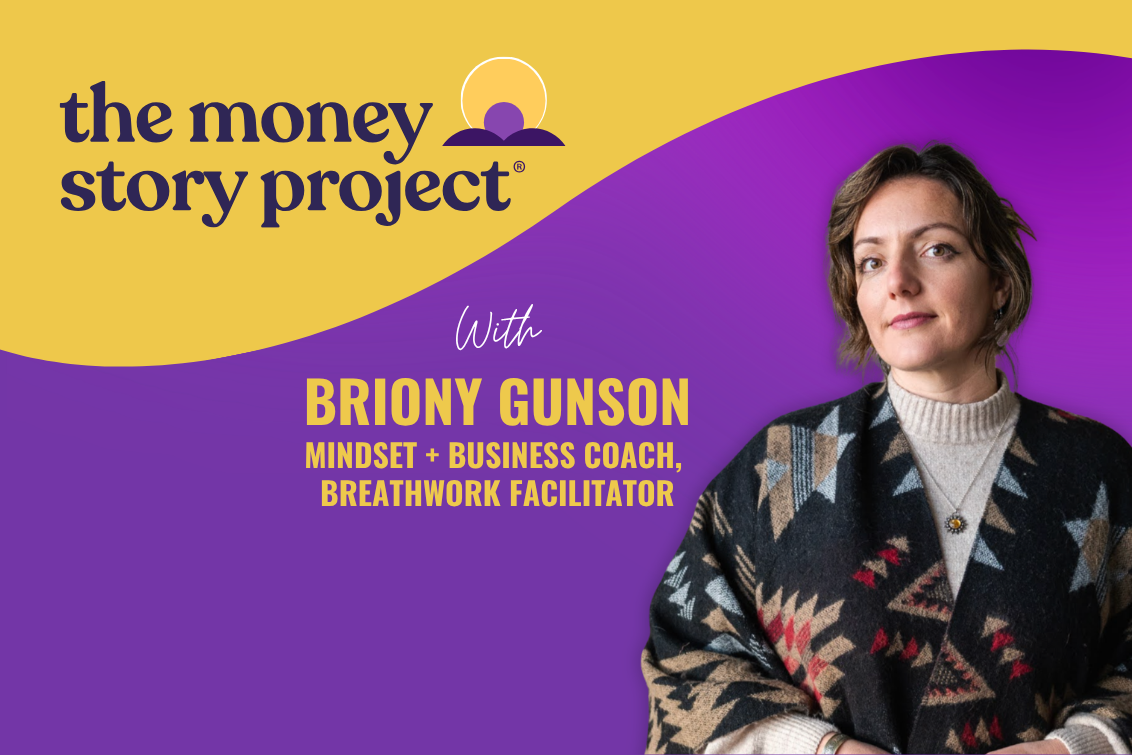
Trauma, Compassion & Change: — with Briony Gunson
What Happens When the Plane Actually Crashes?
There is a metaphor Briony Gunson encountered in Glennon Doyle's book Untamed that stopped her cold. Doyle writes about families as passengers on a plane, the adults as air stewards, the children watching for cues. Turbulence comes. The stewards reassure. It's fine. It's just turbulence.
When Briony read it, she put the book down.
"The f*cking plane crashed," she said. "We'd been experiencing turbulence for years. It crashed."
Unlike a real plane crash, which is investigated, reported, witnessed, Briony's family's collapse happened in a more hidden way. Nobody knew. That silence, and what it cost her, is where her money story begins.
What Money Meant at Home
Briony grew up in Hong Kong, and her earliest memories are of her parents arguing about money. The arguments were a kind of education — the first lesson being that money was terrifying, stressful, and the source of trouble. As she moved into her early teens, the trouble escalated. Her father's professional projects began to unravel. Legal proceedings followed. Court cases. Coverage in the newspaper, though her mother tried to shield the children from that.
Eventually, her father spent time in jail before being cleared of wrongdoing. The family lost everything — their home, their savings, their dogs, their cats, Briony's belongings. She was fourteen.
"It's not an exaggeration to say my family imploded," she said. "It's almost like being hit by a huge tidal wave or an earthquake and just being carried along."

Three of Them, One Room
What came next was a period Briony describes with a clarity that only comes from having spent years processing it. Her mother moved her and her younger sister to the UK. Hong Kong has no welfare state — if you are homeless there, you are on the streets. In the UK, they had access to emergency support, a fact Briony acknowledges with a directness she's clearly earned: "Shout-out to the welfare state."
But accessing that support took time, and in the meantime, life contracted to something very small. The three of them — Briony, her mother and her sister — moved into a single room in a London bedsit. Not even a double bed but something closer to a queen, the three of them sharing it through the colder months, Briony sleeping on the floor in summer. They were there for nine months.
She was also no longer in school. Kicked out of the private school she'd attended for non-payment of fees, she was told the state schools were full. Her sister found a place. Briony didn't. While her mother went out to work and her sister went to classes, Briony was left alone in the room. This was the pre-mobile, pre-internet era — no phone, no computer, no way to reach anyone. "I remember having some GCSE science books that we'd got from the library," she said, "and I was trying to spend my time doing some kind of self-study whilst also taking care of the one room that we were in."
The shower in the building required 50p for hot water. To save money, Briony would do her laundry at the same time. The family's food budget was £5 a day for all three of them. Briony's job was to figure out how to make that work — to plan meals, to cook creatively, to feed them on almost nothing.
"That was extreme poverty," she said. "That's the classification for that kind of living standard. I used to be resistant to acknowledging that. But that's what it was."
The moment that crystallised it came when a woman from the council arrived to assess their need for emergency housing. Briony's mother had stepped out briefly to get milk for the cup of tea she wanted to offer. The woman arrived while she was gone. Fourteen-year-old Briony answered the door, showed her around the single room, tried to make it sound ordinary. People co-sleep, she told her. People share rooms with their families.
"I could feel her warmth and her compassion," Briony said. "And I remember trying so hard to make it okay."
Being seen — formally, officially, by someone in a position of authority — was something she hadn't anticipated. "I guess it's the being seen, right? Like being acknowledged."
The Cost of Keeping Quiet
One of the threads running through this conversation is the question of why Briony's mother didn't tell anyone. Why she maintained the pretence — that they'd moved for the children's schooling, that the caravan they initially stayed in when they arrived in the UK was just a fun jaunt — even as the reality was so much harder.
Her mother, she says, was like a lone tiger — incredibly self-reliant, the kind of person who would just figure it out herself. "I learnt from a young age to do an amazing job of hiding that there could be potentially an enormous shit show happening just behind me."
Briony has spent years sitting with that question. A passing comment from her father unlocked part of it: he was the first of four generations of men in his family not to go to war. Her mother's family had uncles who survived Japanese prisoner of war camps. Both sides of her family had lived through things that made a London bedsit look manageable, even comfortable.
"As far as my mum was concerned, relative to what they went through, you don't have any problems. You've got a roof over your head, food to eat, clothes to wear."
That conditioning — to keep going, to not burden others, to define suffering downward — is something Briony understands now as both a strength and a limitation. It can be remarkable for plowing through difficulty. It can also mean that what doesn't get named doesn't get processed, and what doesn't get processed stays in the body.
"Our body remembers," she said. "If there's a situation that is very stressful and the emotional charge isn't properly acknowledged and processed, it will stay with us. And that's when things can build and build and build — people end up having huge emotional reactions, sometimes to something quite small, because it's nothing to do with the trigger. It's all of that legacy charge."
Education as the Way Out
When Briony eventually got into a school, she threw herself into studying with an intensity shaped by everything she'd been through. From the estate they'd moved to after the bedsit, she could see it clearly — education was a route out of poverty. "I could see that so clearly," she says. "Education is my way out." Working hard became her thing. She was already studious, already geeky — a self-described boffin who loved learning. Now she had a reason that was urgent and real.
When her GCSE results came, she had the highest scores for a girl in her year group.
"I was so singularly focused," she said. "I have to get out of this, and this is my way out. If you want it hard enough, all sorts of things are possible."
She got an academic scholarship to a private school. She kept going. It wasn't until she was an adult that she allowed herself to properly acknowledge what she'd done.
A Huge Gift to Each Other
Briony lost meaningful contact with her father for years. The stress of everything that had happened made staying in touch too difficult, and she stepped away to protect herself. It wasn't until her early thirties, as part of her own healing work, that she gradually tried again — carefully, without expectation, frightened of being hurt.
"I realised one of the things that was hurting me most was being away from my dad," she said.
She approached the reconnection with what she describes as a practice of releasing expectations. Not hoping for a particular kind of relationship. Not needing him to explain what had happened. Just showing up as an adult and being curious about who he was.
"I just showed up as my full-ass adult self," she said. "And it was amazing."
The relationship that developed was one she describes as a hole in her chest she hadn't known was there until it was filled. Her father has since died — both her parents have.
"It's one of the things I'm most proud of in my life," she said. "We were a huge gift to each other."

When Money Feels Fundamentally Unsafe
When Briony began building her coaching business, a business coach pointed out what Briony had partly known but never quite named: her relationship with money wasn't ordinary anxiety. It was something bigger.
"She said: 'Babe, this is a completely different ballgame. This is big. This is really big.'"
The validation was both a relief and unsettling. Because Briony had spent years experiencing it — the cold hands, the shaking, the tearfulness that would come when she needed to deal with larger sums of money, send deposits, think about credit cards. As a breathwork facilitator, she now has language for what was happening: her nervous system was treating money as a threat. Her animal body was responding to a signal laid down in childhood that money is not safe.
"My body was remembering: we are talking about the thing that is fundamentally unsafe."
The work of changing that has been deliberate. She has built processes around money. She reviews her finances consistently. If she hits a point of overwhelm, she lets herself cry, rests, and asks: does this action need to happen today, or can it wait? Is there another adult who can sit with her while she does it?
Love People and Use Money
The work Briony does with coaching clients starts from curiosity rather than judgment. When a block shows up — around selling, around growth, around money itself — rather than pushing past it, she slows down and asks what's really there. Often, she says, the body has formed a belief about money or business or self-worth at some earlier point, and that belief is still running. We can try to push past it, and sometimes progress gets made. But sooner or later, she says, it comes right back. "Like an elastic band — we might feel like we're making progress and then we just snap back to where we were."
She also talks about shame — particularly the shame some women feel around financial success. The sense of disloyalty to their roots if they're the first in their family to invest or save or build. The voice that asks: who do you think you are?
"What if we just go: I'm so privileged. How can I really rock my privilege? How can I really give back? Rather than: oh, I don't think I can do it."
One of her mentors has a line she returns to: "Make sure you love people and use money, not the other way around." It's a reminder that an intentional relationship with money is possible — one that isn't a highly charged emotional one running on autopilot, but something clearer. Money itself is neutral. It's a tool. Not good or bad — it's what we do with it, what we use it for, what we build with it that matters.
Financial Hygiene is Sexy!
Briony is not dismissive of manifestation — she uses affirmations, visualisation, celebrations of small wins to help retrain her nervous system. "Our brains are hardwired to notice what is dangerous or off or risky," she says, "because we're the offspring of survivors. Everyone who came before us was damn good at noticing what's not going too well."
But she is uneasy about how some manifestation content exploits vulnerability. The rags-to-riches story that accompanies the £20,000 course. The sentiment that the greater the price you pay, the greater the transformation.
"Where's the receipts?" she says. "What has the transformation actually been for all those students paying eye-watering amounts of money?"
The most useful thing, she says, is grounding. Visioning and imagining and hoping, and then dropping back down into the here and now. Making the most of what's already here.
"Financial hygiene is sexy," she says. The people who are in the strongest financial position aren't doing the most dramatic things. They're doing consistent, unglamorous habits, month after month. Looking at the numbers. Being curious. Showing up.
The Cards You've Been Dealt
For anyone who recognises something of themselves in her story, Briony offers a Gabor Maté quote as her closing thought:
"We may not be responsible for the world that created our mind, but we are responsible for the world we go on to create with our mind."
The cards we're dealt in life aren't fair. Some hands are much harder than others. But as adults, there is agency — more than we often claim. The work is to separate out what belongs to the present and what belongs to legacy charge, old beliefs, early versions of ourselves responding to threats that are no longer there.
"I'm an adult now. I can make change happen. And I don't have to do it on my own."
That last part matters. Briony has never done any of this alone. She has had coaches, therapists, breathwork, relationships that allowed co-regulation, the welfare state, librarians who kept a warm, dry, free space open.
"Be really compassionate," she says. "Know that you can make changes. Reach out to people you feel safe with. And recognise that change can actually be empowering."
She closes with gratitude to both her parents. "I want to offer thanks and appreciation for my mum and dad," she says. "There's so much that I have learnt. And even if I would've preferred a more simple and straightforward path — there's so much that I've ultimately been able to learn about myself and about life. I don't think any of that would've happened had we not faced that as a family."
About Briony Gunson
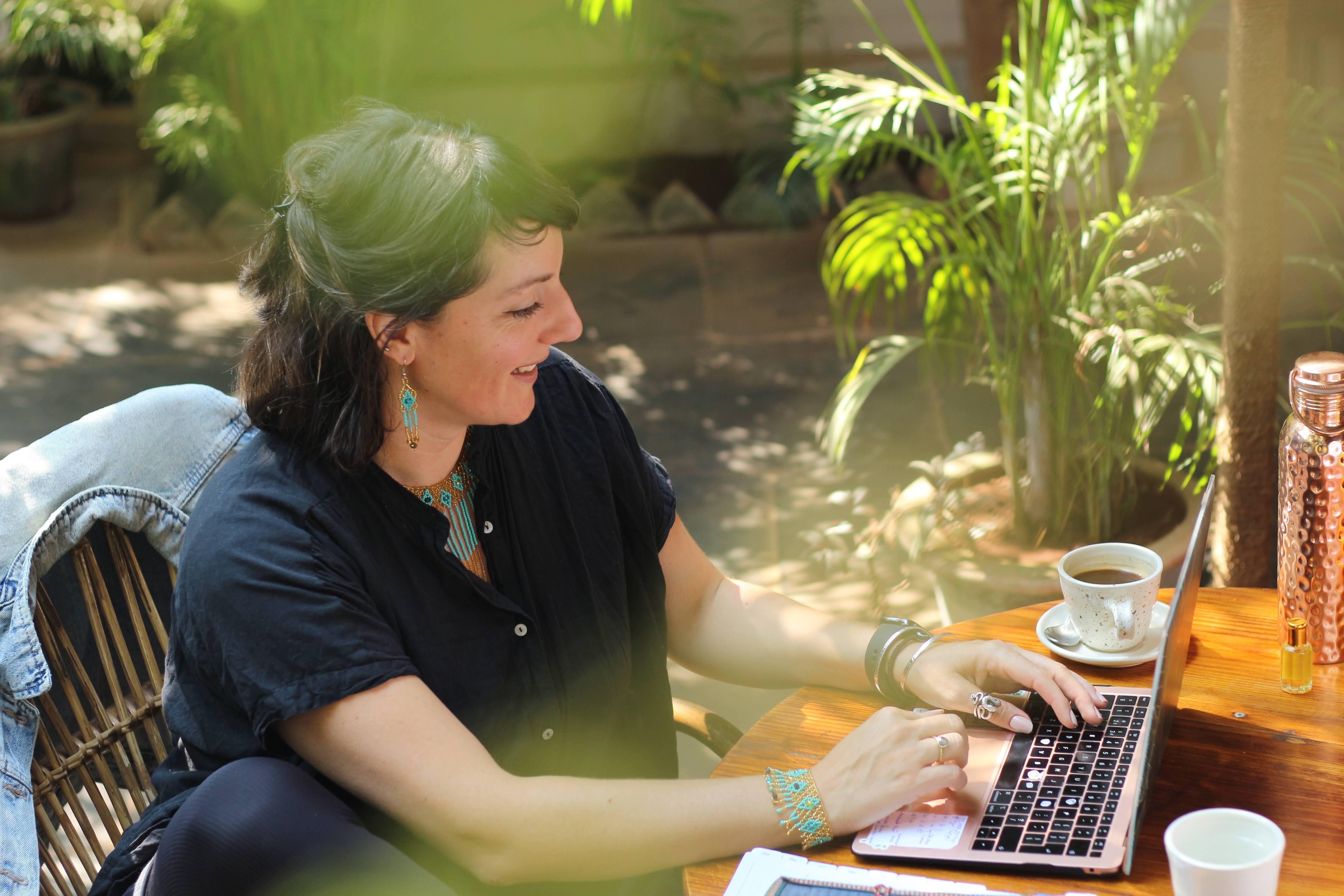
Briony Gunson is a mindset coach, breathwork facilitator, and corporate wellbeing trainer based in the UK. Her work is trauma-informed, blending practical tools with embodied practices including breathwork, meditation, and cold water therapy. She works 1:1 with clients globally, runs workshops and retreats around the world, and delivers corporate wellbeing training on stress, anxiety, and nervous system regulation.
After her own experiences with burnout and a challenging relationship with money, Briony is passionate about helping people — particularly women and female founders — feel more grounded, resourced, and in control of their lives, financially and emotionally. She is currently running a UK retreat, Reclaim Your Inner Power, in May, and a retreat in India in November. Keep an eye on her website and socials for upcoming dates.
Connect with Briony
Website: brionygunson.com
Instagram: @brionygunson
LinkedIn: linkedin.com/in/brionygunson
Facebook: facebook.com/BrionyGunsonMindsetCoach
Briony's Abundance Mindset meditation on InsightTimer - a 20-minute guided meditation on what it really means to be abundant. Particularly cathartic as a response to some of the more damaging manifestation narratives out there.
The Money Story Project
This conversation is part of The Money Story Project — which isn't really about money at all. It's about the stories underneath — deep, human conversations about identity, culture, power, creativity and the hidden stories that shape how we relate to money. If Briony's story resonated, consider sharing it with someone who might appreciate hearing it too.
Listen: Apple Podcasts Spotify
Find out more moneystoryproject.com
Be a guest complete form
Connect with host/interviewer Harriet Formby:
LinkedIn | Instagram | Website
Learn more about The Money Story Project and how to share your own story.
More from the category:
Podcast


Sign up to the newsletter
Where the practical meets the visionary. Stories, tools and ideas about money, plus seasonal meanderings — straight to your inbox.