
Money as a Hidden Creative Collaborator — with Paul Macauley & Laura Mugridge
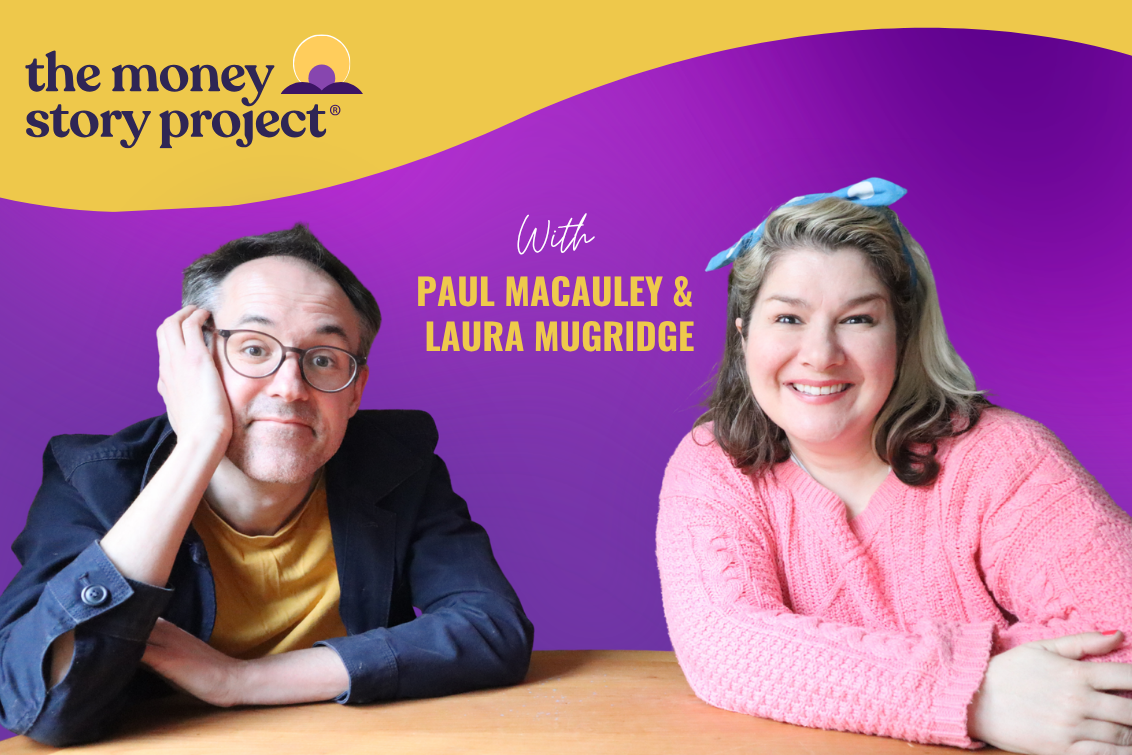
Come and sit over here. Have a glass of milk and a party ring.
The first thing Laura does when asked about money is make a sound. "As soon as I think about the wider issue of money, I just sort of go... uuuuurggghhhhhhhhhee." It's a visceral sound — the kind that tells you a lot about how it feels to talk about money before the words even start.
Paul Macauley and Laura Mugridge are a Brighton-based creative partnership making independent theatre and audio work together. Both award-winning theatre makers with years of acclaimed solo and collaborative work behind them, together they created Inside the Lines — a warm audio comedy about two friends who run Brighton's most unusual business, a colouring-in service. You bring the artwork, they do the colouring. For a small fee of course.
Money, as they both quickly admit, has always been a presence in that work. Just rarely a spoken one — and sitting down to talk about it has brought up more than either of them anticipated. For Paul, the feelings around money are equally visceral. When the subject comes up, there's a tension, a tightening.
Early experiences with money
For Laura, money growing up was consistent and unspoken. Born in Lancashire, her dad was a police officer, her mum worked at an agricultural college. They didn't have fancy cars, or extravagant holidays but there was always enough, and the ebbs and flows of income simply weren't something she was aware of. When she showed an interest in theatre, the advice was clear: have a backup. Get a degree in something else too, just in case. Then she went into the arts, where income is anything but consistent, and the contrast hit hard.
"I've been making my career in a very different time to the one my parents navigated," she says. "And I moved to the South East — the most expensive part of Britain."
Paul traces the visceral feeling of tension around money back to a period in childhood when money was genuinely tight, after his parents separated. As children, he and his siblings were exposed to some of the emotional weight of that:
"We knew not having enough money was an emotive thing. And I think we've all carried that into our adult lives in our own ways."
There was also a message that seeped in about work itself — that it was inherently boring, a necessary evil. Something you did to get the money to survive. "This weird relationship where you don't have enough money, so you need to go and do something you don't want to do, to get what's necessary." It took a long time, Paul says, to start deprogramming that. To land somewhere that feels more like: I can earn enough and I don't have to sell my soul to do it.
"Though I still feel that tension an awful lot."
The compartmentalised self
For a long time, Paul explains, he lived what he identified as a 'split life'. Professional Paul showed up to work. Creative Paul made films and plays in his own time. The two felt entirely separate — and in neither world did he feel like he fully belonged.
"I wasn't really a professional and I wasn't really an artist. I didn't belong in either place."
The shift came from an unexpected direction. He was working in an office when the company he was working for wanted to put on a Christmas pantomime and asked around if anyone could help with that. Paul said yes, and wrote and directed it. Everyone got involved, including directors and managers. It went down a storm. And afterwards, his boss said: "I saw a side of you I'd never seen before."
"To me I was like — well, yeah. That's just what I've been doing outside of work for a long time." But something clicked.
"The stuff that I do outside there has value in this professional context and vice versa."
That realisation, he says, began the healing of that split — the schizoid thing he'd had about himself for years. It opened up new opportunities — and ultimately sparked his freelance and creative life.
"Are you waiting for your next big break?"
Laura, meanwhile, has spent her career doing what people told her couldn't be done. "You need a backup job," was the message when she was studying drama — so she did a joint degree in drama and French. She's never needed the backup, as it turned out, though she did have a lovely time living in France.
What she has noticed, though, is how normalised it's become to make deprecating jokes about people in theatre. Strangers will ask what she does, and follow it with: "Oh, are you just waiting for your big break?" It happened at a bed and breakfast in Stratford once — a man serving breakfast, genuinely asking. "And it really threw me," she says. "That's a really rude thing to say. People wouldn't say that to people in other industries."
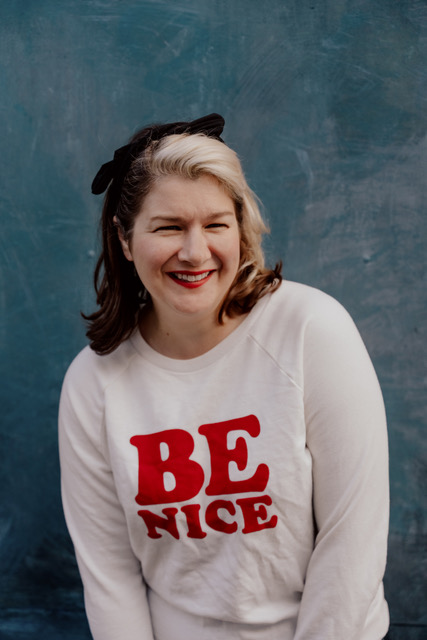
She's proud — genuinely proud — that all of her income comes from theatre and theatre-adjacent work: making shows, running drama camps with children, doing medical role play with Brighton Medical School and Cambridge University to help train doctors. She finds herself getting defensive when people imply some of it is just "keeping the wolf from the door."
"I actually really enjoy the medical role play. I enjoy watching lots of people deal with the same situation in wildly different ways. And people value my opinion there."
"It's just maths"
There's another layer to Laura's relationship with money — one that's closer to home. She moved in with her partner a couple of years ago and they combined their finances. He has a salaried job working for the council. He sees money, she says, as just maths. "That's how his brain works. It's maths." When there's a bill to pay or a budget to make up, he'll ask when she's next getting paid — just trying to make the numbers work.
For Laura, that simple question lands very differently. She hears it as: why aren't you contributing enough to this household? Your stupid job working in the creative industries. She knows that's not what he means. He's just asking to make the maths add up. But the emotional charge around money means even a practical question can feel like an attack on her worth.
She's had periods of housing benefit, working tax credits, rebuilding her life in a new town as a single parent. The panic from those times, she says, has a habit of following you.
"I think maybe I brought the panic with me. I should have just left it there."
The circle of income
Laura describes her income as a circle — multiple theatre-adjacent sources that mean if one drops away, there's somewhere else to turn. She also acknowledges the privilege of having a partner with a steady income, which takes the edge off the blind panic that used to be a constant. For Paul, alongside his theatre making, he works with businesses and organisations helping them tell their stories through video and content creation.
The self-employed rollercoaster brings its own emotional weight too. Paul talks about dry spells — periods when work isn't coming in — and how quickly that translates into questions about his own worth.
"I've had times where I've had dry spells in terms of work. I don't feel good about myself. Do I have anything of value to offer, given the fact that no one is currently paying me to do that thing?" And then there is a particular kind of vulnerability, he says, that comes with tying your income to your creative output.
And yet, he argues, this way of working is more resilient than it might look. He spent time labouring under the illusion that the job-for-life world of their parents' generation — the pensions, the housing security, the whole package — was still available to him. It isn't, he says. And once you accept that, finding your own way starts to look less like a risk and more like a response. "I'd rather be on that edge," he says, "because at least I'm having to figure it out — rather than stagnating at a job somewhere and then emerging from that being made redundant after 17 years and going, what the hell am I doing?"
"Everything is being squeezed"
Laura has been making theatre since 2009 and has watched the funding landscape change dramatically over that time. She remembers when Arts Council funding was, if not easy, at least accessible. She got funding for every bid she made in the early years. "I really took it for granted." Now, working with established companies, she hears of bids going unfunded again and again. "Everything is being squeezed."
Paul has been working more fully in the creative industries for the last five years, so he carries less grief and a little more pragmatism. "Oh, what can we do then?" is his instinct. He is trying to find the positives and sees something new in the shift — the idea that you can have a direct relationship with your audience and don't need a theatre or commissioner as a gatekeeper. "I kind of go, okay — there's not a lot of money from major funders. So how do you tour a show without Arts Council backing? You find theatres who will contract with you on a workable level. You look for fees and guarantees. And when you can't get those, you do a box office split and absorb the risk yourself."
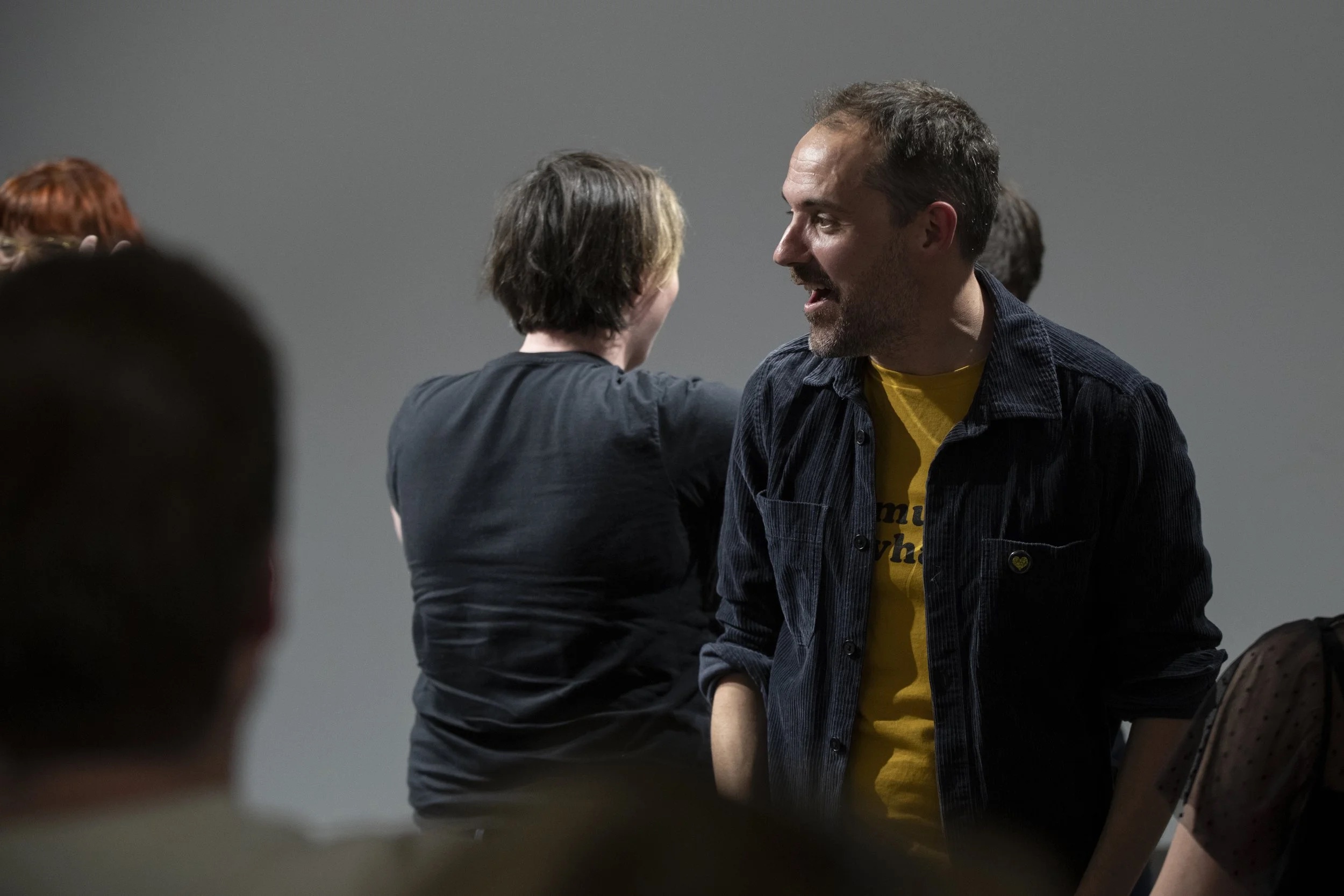
There's something uncomfortable in that, he acknowledges. Artists absorbing risk while already operating on a shoestring. More people chasing less money. And theatres, increasingly, going for tried and tested IP — existing films, known musicals, recognisable brands — because audiences with less disposable income are less willing to take a chance on something new. Something like Inside the Lines, for instance.
"Fewer stories being created," Laura says. "Because we're just regurgitating the old ones."
Paul adds that it also means a lack of diversity in the stories that get told — the cultural landscape becomes safer, more predictable, less representative.
But both of them refuse to stop. Inside the Lines exists precisely because they decided not to wait for permission. "We made the thing we wanted to see," Paul says. "We didn't wait for a commissioner to say yes."
Brunch Gate
Last autumn, Paul and Laura made six episodes of Inside the Lines independently, on a shoestring, with a small team including their sound designer Gwen in Wales. In September they held a launch party — eighty people in a room, colouring in and listening to the podcast together, with a giant party ring cake and Inside the Lines merch. It was everything they'd hoped for, and the culmination of months of hard work.
The morning after, they wanted to take Gwen out for brunch to celebrate her.
"We both sat there in the café," Laura says, "and we both realised — I don't think I actually have enough in my bank account to pay for this."
"And I was also thinking," Paul continues, "I don't think I have enough either."
Because everything had been running through Paul's bank account, Laura had assumed there was money available from the ticket sales. What she hadn't factored in was that money was also going out to pay for the merch and other things — there was a cash flow issue. Paul, meanwhile, had assumed they would split the brunch between them. Neither assumption had been said out loud. They were exhausted, emotional, at the end of their resources.
"It sounds really small," Paul says, "but it says so much about what it's like to create your own work."
They'd worked for five, six months on something wonderful. Nobody had been paid. And in that moment, they couldn't buy brunch.
They've named it 'Brunch Gate'. In the moment, Paul felt embarrassed, annoyed, frustrated. "I didn't know how to pay the bill." Laura adds: "We were both just so tired and emotional. Which is the worst time to be dealing with money. But we learned so much from that."
It all got sorted. Gwen got her free brunch. And it opened up conversations they needed to have — about how the money works, where it goes, and how it gets split.
One of the things that came out of 'Brunch Gate' was a commitment to saying things out loud.
"That's what takes the power out of money," Paul says. "Actually just saying it out loud."
Laura learned a similar lesson years earlier — after a project where demands on her time kept creeping because nothing had been formalised. Now she gets things in a contract, even with people she knows socially. "You've got the maths to back it up. And then you don't have to negotiate emotionally."
She has a name for that last bit. Emotional negotiation. And it's horrible.
Commercially minded, not commercially driven
One of the things that's emerged from making work together is a set of shared principles around money. Paul articulates them clearly: cover your costs, always. Find ways to make what you make pay for itself. Be commercially minded, but not commercially driven. And — most importantly — relationship first, then the art, then the money. In that order.
"Laura goes quiet around money," Paul observes. "Or makes a noise."
"I make a noise," Laura agrees. "And Paul probably overthinks it and puts it in a spreadsheet nine months in advance."
The spreadsheet, Paul explains, is about control — and that need for control ties directly back to his childhood, when money felt like something that happened to him rather than something he had any agency over. "I want agency and control. I want to feel like I have some say over it." Making his own work, on his own terms, is part of that — he doesn't want his ability to make the thing he wants to make to be determined by whether someone else says yes or no.
Neither of them thinks their own approach is right. "I don't think my way is good," Laura says, laughing. "It's flawed." But the overlap — where their different money stories meet in the middle — has produced something that works. And the experience of 'Brunch Gate' has led them to have much deeper conversations about money, both with each other and with the team around them.
There's guilt in there too, Paul admits. Wanting to pay people properly and not being able to. Knowing that if Inside the Lines were a fully commissioned BBC Radio 4 production, everyone would be getting thousands.
"The answer isn't that people do it just for money. There are projects people want to do because they love them and believe in them. But that's hard to hold."
A vote for what you want to see
With more traditional sources of arts funding harder to come by, the crowdfunder feels like a response — a way of going directly to the people who want the work to exist. They're now preparing one for series two of Inside the Lines. And the way they're thinking about it has shifted.
Not: "please give us money." But: "here is how you can be part of something."
Because as Paul puts it, where you spend your money is a vote for what you want and believe in.
Laura talks about what it feels like on the receiving end — how she'll happily contribute a fiver or a tenner to a crowdfunder if she thinks it's a lovely project. "I love to be part of that." And Paul speaks about wanting to hold the whole thing open-heartedly. "We've built a world. We want to bring people into it."
There's still grief in there, for Laura — for the funding landscape that used to exist, for the artist-in-residence residencies and the Creative Partnerships work that's gone. "I'm experiencing a kind of grief," she says. "It was always hard, but it feels now like the floodgates have opened." But alongside the grief, there's something else.
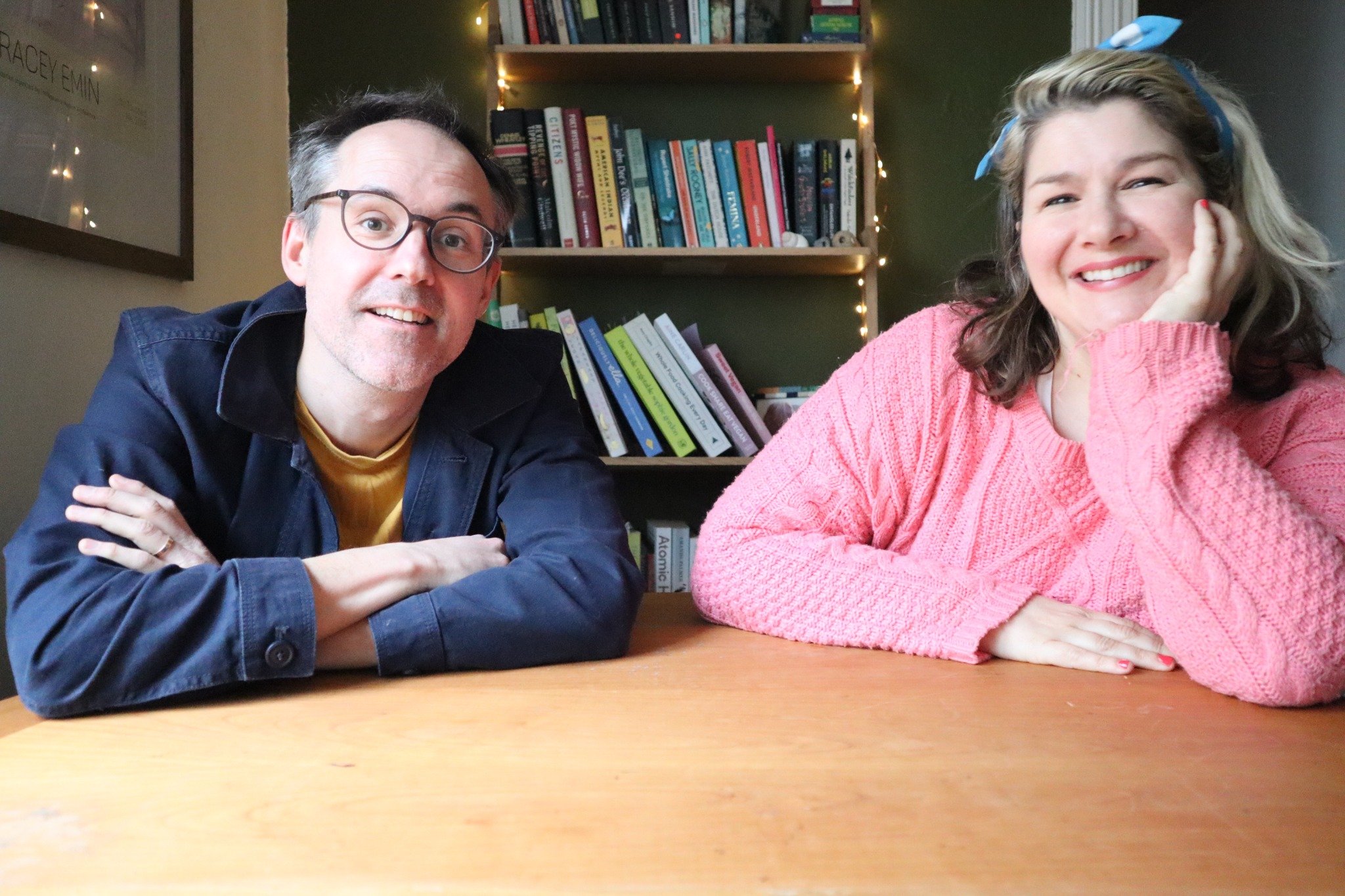
Joy as resistance
Laura is clear that this isn't about escape or pretending the world isn't difficult. "It really does matter what's happening in the world," she says. "It really, really does." But what she and Paul can offer as artists is something different — a moment to come up for air before going back in.
"Come and sit over here for a minute. Have a glass of milk and a party ring. Because you can't go out and battle the world if your nervous system has gone horribly wrong. So we are like — why don't we help reset that, and then we can fight, in our own gentle ways."
Paul agrees. "I think it's a rebellion. A resistance." And he means it. There's something quietly radical, he says, about making warm, silly, cosy things in the middle of everything that's happening — choosing to create joy when the world is pulling in the other direction.
There are artists, Laura says, making incredible activist work — huge pieces that change big things. "And that's really valid and very helpful and what we need. And also — come and sit over here."
Joy, as its own form of resistance. Not waiting for the perfect conditions. Not waiting for permission. Not waiting for a commissioner to say yes.
"If it's the thing that you feel is yours to do," Paul says, "then you have to find a way to make it happen."
Inside The Lines
Inside the Lines series one is out now on Apple Podcasts, Spotify, YouTube, and wherever you get your podcasts.
The crowdfunder for series two launches 1st June: https://www.crowdfunder.co.uk/p/inside-the-lines-series-2
Follow Inside the Lines on Instagram: @insidethelinescomedy
Connect with Paul & Laura
Find Laura on Instagram: @lauramugridge
Find Paul on Instagram: @paul_macauley
The Money Story Project
This conversation is part of The Money Story Project — a storytelling space where we explore what money means, and how we're all carrying it differently.
Listen: Apple Podcasts Spotify
Find out more moneystoryproject.com
Be a guest complete form
Connect with host/interviewer Harriet Formby:
LinkedIn | Instagram | Website
Learn more about The Money Story Project and how to share your own story.
More from the category:
Podcast
Sign up to the newsletter
Where the practical meets the visionary. Stories, tools and ideas about money, plus seasonal meanderings — straight to your inbox.