
War, Risk & Rebuilding: Nothing Lasts Forever - with Viktor Popovic
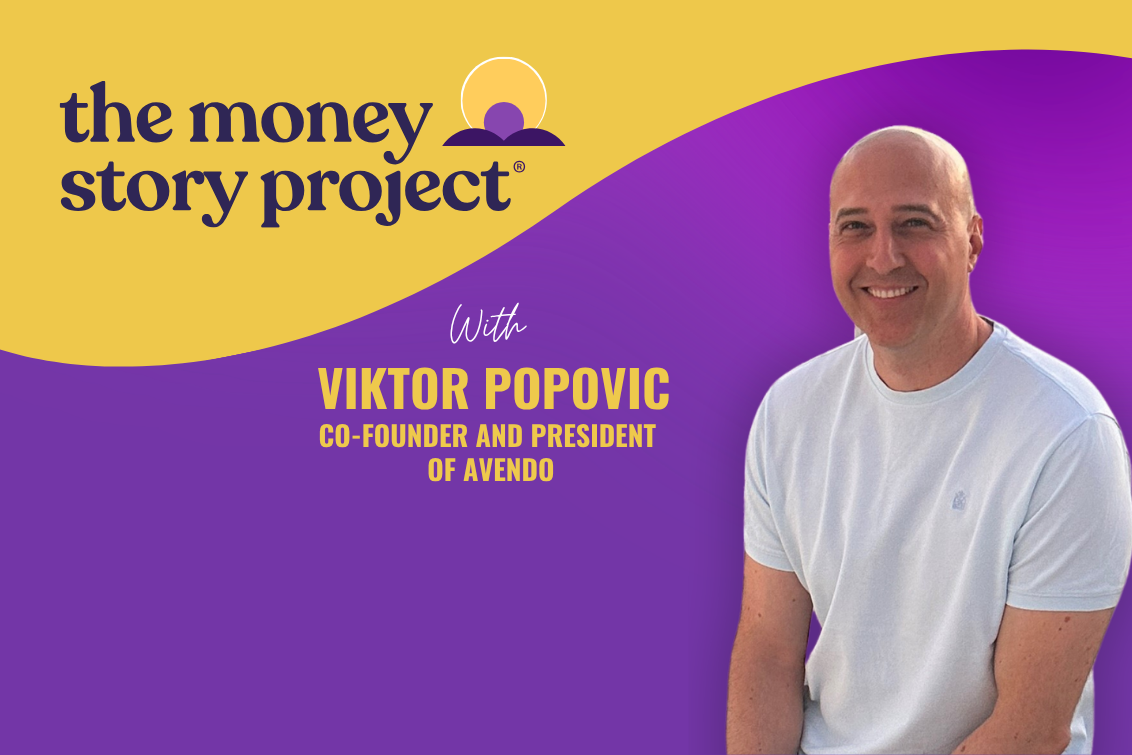
Viktor Popovic was seventeen and a half, about to enter his final year of high school, when the civil war reached the former Yugoslavia. His father, a customs inspector, had died a few months earlier. His mother worked as chief accountant at a courthouse. And then, almost overnight, the ordinary, middle-class life he'd grown up in was gone.
"From kind of middle comfortable level growing up to very tough beginnings," is how he puts it now.
Viktor is the co-founder and president of Avendo, a fintech SaaS company helping merchants get transparent, competitive payment processing rates. Before that, he spent 21 years building Ultimate Washer, a pressure washer e-commerce business, from a $3,000 investment into a nationally recognised Amazon operation — one he successfully exited. But his money story starts long before any of that, with a war, a mixed-heritage family caught on the wrong side of a draft, and a decision, at seventeen, to leave.
Growing up under Tito
Viktor grew up under Josip Broz Tito's one-party Communist rule — 35 years of dictatorship by the time of Viktor's childhood, no political alternatives, and real consequences for stepping out of line.
"You couldn't even resist," he says. "People would simply disappear."
His family lived on the fourth floor of an apartment block; everyone knew the man on the fifth floor worked for the Secret Service, and knew to be careful what they said around him.
The war reaches him
That was the backdrop his family's ordinary, middle-class life sat inside — until, a few months after his father's death, the civil war reached them. It started in Croatia in 1991, then spread into Bosnia, and nobody could say with any certainty where it would go next, or who it would pull in. Viktor came from a mixed Serbian-Hungarian family — his father Serbian, his mother Hungarian — which put him on the Serbian side of a war that had started actively drafting young people from mixed marriages into the military.
He enrolled in a mechanical engineering degree he had no interest in, because Serbian law exempted medical, electrical, and mechanical engineering students from the draft. It bought him time, not a future. As the war escalated, he made the decision to leave for Budapest, where a friend offered him a place to land.
Half a suitcase
"Started brand new life from literally nothing. Half a suitcase, maybe," he says.
Hungary itself was a shock. It had only come out from under Soviet occupation a few years earlier, and was still visibly poorer than Yugoslavia, which had stayed outside the USSR bloc.
"Every third or fourth household had a washing machine. People washed clothes by hand. To us, that was very shocking — it wasn't that bad in Yugoslavia," Viktor says.
He claimed refugee status and started building a life from there — learning Hungarian from scratch despite his mother being Hungarian, since he'd never spoken it growing up, and working out the legal system, the language, and how to find work with no local contacts and only a high school diploma behind him. His first job was at a clothing factory, ironing garments as they came off the production line. He later moved to a job at Budapest airport with Delta Airlines, which didn't require fluent Hungarian — his school English was enough.
No favourite restaurant
Viktor was seventeen. His girlfriend Rose — now his wife, — was the same age, and had some savings, a thousand Deutschmarks or so, enough to cover a few months while they got settled. When the wages started coming in, they weren't much: around 50 pfennig an hour, roughly half a Deutschmark — half a euro today. "It's tough. You learn how to manage your money, somehow."
Once the savings ran out and it was just the wages, that's when it got hard.
"I remember us at the end of the month cherishing — like at the end of the month we're like, 'Hey, we saved five Deutschmarks.' And that was a success story for us. It builds a character, I could tell you that."
For fun, for a while, this was it: "We would go to McDonald's, and we would buy a hamburger — not a meal, not a cheeseburger, just one plain hamburger. That's how much money we had. Then we would split it, so I'd get half, she'd get the other half."
And still — this is the part that seems to matter most to Viktor, looking back — "we were still happy. We weren't complaining. I don't know, looking back now, how in the world were we just so patient?"
Years later, visiting Budapest again after immigrating to the US, he and his wife thought it would be nice to return to their old favourite restaurant. There wasn't one. "We never went to a restaurant. We don't have a favourite restaurant. Like, four years living in Hungary — is it possible? That's how it was."
Another planet
Eventually, the couple made it to the United States, arriving in Chicago. "We landed, we're like, 'This is not another world, this is another planet.' Everything is bigger, wider, taller. It's nothing like in Europe. European countries are pretty similar to each other — this was a big shock."
What struck him most, though, wasn't the scale of things.
"The biggest difference for us was really the people. Very welcoming. It didn't matter where you were from — people are so encouraging. 'Hey, you should try that. Let me connect you with this friend, he did something similar.' Very motivating."
What took longer to adjust to was the economy itself: a consumer-driven culture where spending, not saving, was the norm — a real shift after years of counting Deutschmarks.
Staying legally meant years of visa purgatory — temporary visa, to student visa, to a first working visa, to a second, and only after all of that, permanent residency. "There's always the back of your mind: what if I can't renew my student visa? What if I can't renew my work permit?" Every change of administration meant the rules could shift again, with no way to predict which way. Viktor became so well-versed in the different visa categories, checking anything that might apply, that his wife told him he should have become an immigration attorney.
Staying in the country legally meant one of them had to be enrolled in study — that was the route to a visa. They had to decide who would go first; his wife pointed out his English was better, so he went first, then she went on to complete a seven-year pharmacy doctorate once he'd graduated. Neither took a student loan or government support; everything was self-funded. Viktor studied airport management, a natural continuation of the aviation work he'd done in Budapest.
Right place, right time
It didn't lead where he expected. He graduated straight into the aftermath of 9/11, when the US aviation industry was shedding staff, not hiring. Viktor ended up fuelling planes at a small airport for eight dollars an hour — until a chance reconnection at a wedding, for someone his wife worked for, where he found himself seated at the same table as a man named Paul. They clicked at the table, and a couple of days later, completely out of nowhere, Paul rang: "Do you wanna start an e-commerce business with me?" "Without thinking, without knowing what we're doing, who's gonna do what, I said yes."
The business was meant to sell aviation products. A keyword search pointed somewhere else entirely: high search volume, almost no competition, for pressure washers. Viktor, who'd never touched one in his life, spent six months convincing the first factory willing to work with him — Cam Spray, out of Iowa — that these machines could be sold online at all, in an industry that ran entirely on reps demoing them door to door.
"They're like, 'What are you talking about? How are you gonna demo?' I'm like, 'We're not. We're gonna have pictures.'"
The whole thing started on $3,000. Paul put in the money as a silent partner; Viktor put in the sweat equity. The plan was for Paul's wife, a web designer, to build the site — but she and Paul got busy with their own business, so Viktor taught himself the software instead, learning just enough to edit images and publish content. They listed 50 or 60 products from that one factory and went live. From there, it grew into a real operation — customer service handling calls from people spending real money on equipment, and eventually a warehouse team to pick, prep, and pack orders as the business scaled.
It worked. For over a decade, it worked very well — built on the back of genuinely useful, expert-level content, at a moment when almost nobody else in the category was publishing any.
The algorithm changed overnight
Then, in 2015-16, Google rolled out the Penguin algorithm update, and more than a decade of work started disappearing under him.
"Going from top page one to page three and four, which pretty much, if you're page two, you don't exist. Nobody goes to page two anymore."
He watched it happen in real time — the traffic plummeting, the phones going quiet, the calls that used to come in just not coming. His own staff started wondering out loud what was going to happen next, and he didn't have an answer for them yet.
Then it got worse. His business partner chose that exact moment to say he wanted out — he'd sold another business of his own and was ready to retire. So now Viktor was facing two decisions at once, with the company at its weakest: buy his partner out, or sell together while it was down. "Since I just lost all the traffic, I don't think the buyer would give me top dollar," he reasoned. So he bought his partner out. He was now the sole owner of a business that had just lost the thing that made it worth owning.
Betting it all again
Alone with the decision now, Viktor made the harder call: go all in on Amazon. That meant becoming, overnight, an inventory management business rather than a drop-shipping one — a much bigger warehouse, hundreds of thousands to millions of dollars tied up in stock, new bookkeeping systems, new fraud protections, an expert consultant on retainer, and a three-year lease with no way out of it if it didn't work.
"I told my wife, I have to put in a few hundred thousand dollars into the business. This may not work. I've never done this."
He was on his own now — responsible for staff, for the extra cost of consultants, for a decision nobody else could make for him — and all he could tell her was "hope it works." Asked what that felt like, he doesn't dress it up: "It was scary."
Some staff left on their own during that period, sensing the business might not survive. Others agreed to help through the transition, splitting their time between the warehouse and the phones. Looking back on it years later, one of his general managers told him something that's stayed with him: "I feared every day that I was next." "It's hard," Viktor says now. "You know what your employees are going through. It's not easier for them, and you're responsible. They come to work every day, they're loyal to you, and you want to take care of them. Those are really tough times for an employer to go through."
Nothing lasts forever
Before the crash, selling had never crossed his mind. "Building the business and being successful for many years, I thought:
'Why would I ever sell? This is great.' I can go on vacation, I can work remotely, I have staff that are reliable, that are loyal."
Then the Penguin update hit, his partner walked away, and he had to bet everything on Amazon just to survive. "And then you recognize that nothing lasts forever."
It worked. Ultimate Washer not only recovered but, by Viktor's account, ended up performing better than it had before the crisis. But something in him had shifted. Twenty years in, with the business stable and no longer in distress, he made the decision to sell — not out of exhaustion or defeat, but something closer to humility. "I think I gave it my all. I think there might be somebody younger, with maybe some fresher ideas, that can take this company to the next level." Finding the right broker mattered too, he says — something he now tells other business owners to take seriously, having heard enough horror stories from people who didn't.
"I've no regrets. I'm leaving it in good hands."
Who are you without the business
The business was thriving when he sold it, and every employee stayed on. But when you've run something for over 20 years — lived and breathed it, built your days and your identity around it — what's left of you once it's gone?
"When you're going from 100 miles an hour, solving problems every day... to you're waking up and you don't have 20 or 30 emails to answer to — it's quiet."
Money can create freedom, but it doesn't automatically answer the question of who you are without the business.
He'd tried to prepare for what came next. "Freedom after the exit was not as simple as expected," he says. "On paper freedom sounds easy and great — but when you live through the challenges and pressure of business for 21 years, that freedom can really feel strange at first." He'd read a lot of exited founders' interviews beforehand, trying to plan for it as best he could.
That reading is what led him to build himself a "life after the sale" list in advance — what he personally wanted to do, what he wanted to do with family, and a pile of business ideas he'd jotted down over the years and never acted on. He also identified that he wanted to learn a new language, so he decided to learn Spanish — deliberately keeping it low-pressure: if all he did that day was one lesson, nothing else, that counted as a good day.
"I really wanted to release myself of any pressure that I have to do something special, that I have to be busy."
Money is not just numbers
For anyone who recognises pieces of their own journey in Viktor's, but isn't as far along, here's what he'd say:
"Money is not just numbers. Money can represent safety, pressure, responsibility, freedom, fear. Control. And my relationship with money changed through really every chapter — starting with very little, building the company, carrying all that responsibility, selling the business, and then starting again."
And then, once you've built enough: think beyond the revenue, and give back. Viktor and his team have donated equipment and hours to a local builder constructing homes for underprivileged communities. He's also become the person other founders call with questions — not because he set out to be a mentor, but because people came to him hustling and trying hard, and it felt good to say "try this way, try that way."
"I think the important thing is that business owners remember to look beyond the revenue. We have responsibility as business owners... once you build enough, be aware there are other things and other people that may need help."
A fresh challenge
There's a pattern across Viktor's whole story: he keeps ending up at the front edge of something new, learning it from scratch under pressure — pressure washers online before anyone else was doing it, Amazon before most competitors had moved, and now Avendo. Put that observation to him directly, and he doesn't take the credit as easily as you'd expect. "It was just a sequence of events. It's almost like you were strong-armed into it — but then again, you have to be fair and take some credit too, because we didn't just give up."
He also owns a trait that comes with it. "I think I'm built that way where I like the research, I like to understand it. That could also be a hindrance for a startup, because I like details — I sometimes have a tendency to want to know a little too much, and I may slow things down." He describes it as a genuine balance to find: you can't always wait for perfect information, sometimes you just need enough to make the decision.
Avendo grew directly out of something that had bothered Viktor for years as a merchant himself. As a business owner, you pick a credit card processor at the start, sign the agreement, and you're locked in — trusting you're getting a fair rate, with no real way to check. The monthly statements can run five, ten, fifty pages of fees. "
You look at it, you go 'okay,' you flip through it, you don't understand it, you hand it to your accounting department, and that's it. You forget about it. Month after month. That bothered me — there's no way to know if I'm paying the best rate."
Avendo is his answer: a fintech SaaS platform that lets credit card processors compete on price in real time. Every time a customer swipes or enters a card, the transaction data goes out to multiple processors, they return their rate in milliseconds, and Avendo routes it to whichever offers the best deal — invisibly, with no change to the customer's experience. "If you can save even 1% on credit card processing, that's a lot. In e-commerce, you might be running an 8, 10, maybe 12% net margin. Add an extra 1%, and that's 10% more net margin at the end of the day."
Boy, was I wrong!
Building it meant learning an industry from scratch. "I thought I knew payment processing. Boy, was I wrong." Issuing banks, networks like Visa and Mastercard, acquiring banks, processors, ISOs, referral partners — a whole background economy of people, all running something, all making money, that most business owners never see. PCI compliance alone meant wading through 400 pages of legal documents — work that would have cost a lot more if his son, a practising attorney, hadn't been hands-on alongside him from the start, handling the legal side directly.
Starting Avendo has also felt different in one specific way. Building Ultimate Washer from nothing meant a hard financial floor — spend the money and it's back to a 9-to-5 job. This time, that isn't hanging over him the same way. "I don't have that pressure now like I had with Ultimate Washer... at least personally, you don't feel that pressure when you're starting a second time."
About Viktor Popovic
Viktor Popovic is the Co-Founder and President of Avendo, a fintech SaaS company rethinking payment pricing for online merchants. Before Avendo, Viktor spent 21 years building Ultimate Washer from a small startup into a nationally recognized eCommerce and Amazon business, which he successfully exited.
His story begins much earlier, after leaving the former Yugoslavia during the civil war and rebuilding his life as an immigrant and refugee with very limited resources. Viktor's money story has been shaped by survival, responsibility, entrepreneurship, risk, resilience, and starting over more than once.
After selling his first business, he began reflecting on what money can and cannot solve, including identity, purpose, freedom, and the emotional side of life after an exit. Today, he is building Avendo from the lessons he learned as both a merchant and founder, with a focus on transparency, net margin, and helping business owners gain more control over one of their most important recurring costs.
Listen to the full conversation with Viktor Popovic on The Money Story Project®, wherever you get your podcasts.
Connect with Viktor Popovic
Avendo · Avendo partner/resources · LinkedIn
Avendo is currently focused on e-commerce businesses in the US, with a rollout to Europe planned soon. Get in touch with Viktor if you'd like to look at how you might be able to save on processing fees.
Separately, Viktor is also looking for referral partners among fractional CFOs, accounting firms, and business coaches — the people closest to a business's real numbers.
The Money Story Project
This conversation is part of The Money Story Project — which isn't really about money at all. It's about the stories underneath — deep, human conversations about identity, culture, power, creativity and the hidden stories that shape how we relate to money. If Briony's story resonated, consider sharing it with someone who might appreciate hearing it too.
Listen: Apple Podcasts Spotify
Find out more moneystoryproject.com
Be a guest complete form
Connect with host/interviewer Harriet Formby Fractional CFO & Trauma Informed Coach:
LinkedIn | Instagram | Website
Learn more about The Money Story Project and how to share your own story.
More from the category:
Podcast

Sign up to the newsletter
Where the practical meets the visionary. Stories, tools and ideas about money, plus seasonal meanderings — straight to your inbox.