
Neurodivergence, Money & Value: A Gilded Cage Is Still a Cage - with Matthew Bellringer
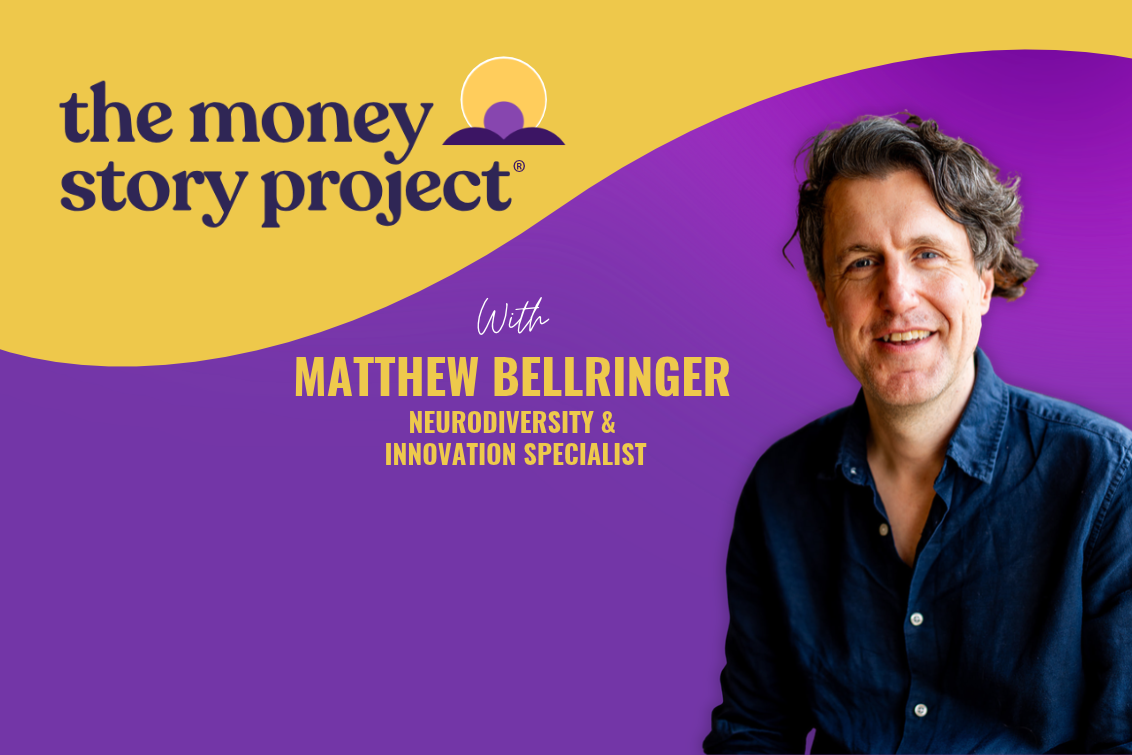
"I'm aware that I had this really interesting relationship with money," says Matthew Bellringer. "I've seen it as a way of solving problems. And particularly the problems that come up around neurodivergence."
Matthew is a neurodiversity and innovation specialist who works with neurodivergent professionals, execs and business owners, helping them build a working life fully aligned with their talents, passions and values.
Their own money story starts in what they describe as relative abundance, with a dad who was a social entrepreneur and started a charity, so the whole family lived through its startup phase. Holidays were taken in this country, there were never any big flash cars, and money was never about display for anyone in the family, though there was always money for books.
Matthew knew from a young age that they were neurodivergent ("not as neurodivergent as it turns out I am"), and the family had the resources to send them to an independent school that offered far more support than the local state system could. Money was practical, something that could solve problems. The basics were always covered, but sometimes something unexpected came up and there wasn't always enough to deal with it. That left Matthew with a mixed relationship with what money was for, and a sense that it's worth keeping some back, because "there might be something we haven't thought of yet".
Alongside that came another lesson: being raised to weigh up value rather than price. "Is it worth spending more? Where is the best price-value ratio? Not what's the cheapest." That way of thinking runs through everything Matthew has done since, from a first business that failed to multi-million-pound purchasing decisions, and on to the way they price their own work today.
A lesson that cost less than university
In their early twenties, Matthew set up a mobile LAN gaming business. This was before everyone had broadband, when people would bring their computers to one place to play games against each other, and Matthew's business took those events to leisure centres and big halls. Eventually, the business ran out of money completely. Matthew had to move back in with their mum and get a job all of a sudden to pay off the debts. It was the first time they had been significantly in debt.
At the time, it felt like a disaster. Looking back, Matthew sees it very differently. "I learnt an awful lot. I got a next job out of it," they say. "In some ways it cost less than university."
"In some ways it cost less than university."
Every pound we spend
That next job was at a charity, and it changed how Matthew thought about budgets. People tend to assume charities are softer than businesses when it comes to money, but Matthew found the opposite. A business can borrow against its future, whereas a charity is "either solvent or they're not", and every pound spent is a pound not spent on service users. Matthew learned to do a lot with relatively little.
From there, Matthew moved to a university, first to an academic department and then to the central IT service, where budgets were orders of magnitude bigger and purchases ran into the millions. Matthew describes it as "slightly vertigo-inducing" to write a report and realise that what you write will strongly influence how a very large amount of money gets spent. "My word here is very significant," they remember thinking. "How do I say this in a way that captures the truth?"
At that scale, small differences added up fast. Choosing between a £623 and a £635 computer for staff could add £100,000 to the budget once it was multiplied across the whole university. But staff time had a cost too. Matthew and their team worked out that sending a technician to look at a single computer cost the organisation about £150. "So if we're talking about a 600 pound computer, that's only four touches before the whole value of the computer is eclipsed by the value of the technician."
This is where Matthew's way of thinking about value came up against the institution. Matthew managed a team of senior IT staff whose salary budget ran well into the hundreds of thousands, with very little oversight of how their time was used. Yet buying anything beyond what was in the stationery cupboard or the pile of drop cables meant making a formal case. "Some people were much, much keener to value purchases than staff time," Matthew says.
So Matthew spent years arguing for total cost of ownership: what something costs across its whole life, not just the price of putting it on the desk. A computer used for four years and left on for much of the day uses a lot of electricity, so a model that costs slightly more but runs far more efficiently could work out cheaper overall. Colleagues would carry out detailed evaluations of every feature, but no one looked at the whole cost, so that job fell to Matthew. It often meant arguing to spend more for better value, which put Matthew at odds with colleagues who simply wanted the cheapest option.
"Some people were much, much keener to value purchases than staff time."
Matthew can see now how frustrating that was, and how common it is. Spotting patterns in data that others miss is "not an uncommon experience amongst neurodivergent people", and the instinct is often to present the data and expect everyone else to reach the same conclusion. Not everyone thinks in data, though. The responsibility to adapt doesn't sit only with neurodivergent people, Matthew says. Colleagues can build skills too, especially the ability to stay curious when something sits outside their own lived experience. Matthew is also honest that being heard came more easily to them than it does to many: "I'm also lucky that I have the right accent and the right skin colour, and I'm man-shaped, and I'm quite tall."
Chopping your head off for a headache
Matthew's work draws on complexity thinking, and in particular on what are known as "wicked problems": tangled, thorny problems that resist being solved. You might not fully understand where you are or what the end point should look like, and fixing one part of the problem can make another part worse.
That's why Matthew prefers to talk about addressing wicked problems rather than solving them. "If you have a headache, there is one very certain way of solving that problem, which is to chop your head off," they say. "But it's not a desirable outcome." Holding on too tightly to solutions, Matthew warns, can be "the organisational equivalent of chopping your head off for a headache".
"If you have a headache, there is one very certain way of solving that problem, which is to chop your head off."
The polycrisis, sometimes called the everything crisis or metacrisis, is the biggest example of all: economic systems under strain, climate change, conflict and world events, all piling up at once and feeding into each other. Matthew calls it a super wicked problem, a wicked problem made of wicked problems, and sees it playing out in how institutions are failing and how much faster big companies now go under, often in spectacular and unpredictable ways. "Companies used to spend 50 years in the FTSE 100," Matthew says. "Now they spend, like, 10 on average." Research on the US stock market shows the same pattern. That unpredictability causes harm, and it can feed on itself: people get scared and put their money into narrower places, and when those fail, they get more scared still.
Matthew also shared a way of thinking about money as options on the future. "If I have money, I have options." As systems start to crumble, though, the options money can buy shrink with them. A painting might be worth millions, but if the art market disappears, what is it worth then? "Am I bartering my Picasso for a loaf of bread?"
The flip side, Matthew says, is that "perspectives create options", and this is where neurodiversity matters so much. Someone who comes at a problem from a different angle is likely to ask different questions, and different questions can open up ways of working with it that simply aren't visible from the conventional view.
When shareholder value is the default, everything else comes second
Shareholder value is built into business from the very start, Matthew points out. When you register a company, the standard articles of association, the core rules of the company, are written around that default, and company law backs it up: under section 172 of the Companies Act 2006, directors' duty is to promote the success of the company for the benefit of its shareholders, with employees, communities and the environment only things to "have regard to" along the way. You can challenge that and create something different, but it takes more effort, and it can make lenders or partners more wary.
Startup culture works the same way. As Matthew puts it, people start things up "with an eye to the exit", and most of the support available nudges founders towards raising investment, growing as fast as possible and selling up. For Matthew, that's very strange. "For me personally it's not the slightest bit why I started a business." Incubators, investors and the whole ecosystem of service providers and projects built around them often depend on that model too: "Their survival as a business will be dependent on your business doing that." As Harriet pointed out, the whole model expects a lot of businesses to fail. Investors accept that many will collapse, because one or two will become unicorns and deliver all their returns. It's fine for great ideas to fall by the wayside, because in the end it's about shareholder return, not overall value or contribution.
"For me personally it's not the slightest bit why I started a business."
If you're building something for the long term, out of passion and meaning, you'll probably need a very different approach: slower, more sustainable growth that stays within your personal limits, and allies rather than competitors. "We're not competing with people who are solving the same problem as us when that problem is so big that we're never gonna solve it." Matthew admits the conventional idea of networking can feel "utterly repellent" to a lot of neurodivergent people, but finding people who are working towards the same thing is something else altogether.
Matthew lives their values in where money comes from and where it goes. They won't work with a large cloud provider whose green credentials aren't good enough, they don't market on a big social media platform whose impact on the world they disagree with, and they try to avoid work that just makes rich people richer. Sometimes that means compromise: choosing the best option available now, while knowing you want to keep moving towards something more aligned.
Success in a business you don't like is a gilded cage
For Matthew, success is simple: "The business is successful if you think it's doing what you want it to do for you and in the world." Holding on to that takes a lot of resistance, though, when social media is full of people telling you you're not a successful coach unless you're turning over six figures. Those messages are loud, Matthew says, but they're very often not in your interest. They tend to serve someone else, who makes money when you adopt their model.
Matthew borrows an idea from lean agile thinking: vanity metrics. To manage something you need to measure it, but what you choose to measure can distort how you see the world. Money, and turnover in particular, can easily become a vanity metric. A company turning over huge sums without making a profit might look impressive, but is it doing any good in the world? Triple bottom line reporting, which looks at financial, social and environmental results together, is one way of checking whether your measures are working together or trading one off against another.
Harriet pointed out that big turnovers can also rest on precarious foundations, like ad spend that stops working the moment a platform changes its algorithm. Being smaller and leaner, and able to keep going year after year, might be far more of a success, whatever success means to you. For Matthew, this comes down to control. Handing it over isn't always wrong, but it should be a conscious choice, and anything you can't influence should be a partial bet you could survive losing. "Otherwise you're betting all of your business on someone else's business model that you have no influence over, which is a very precarious place to be."
"Being successful in a business you do not like is a gilded cage, but it's absolutely a cage."
It also comes down to where you want to spend your energy. Harriet often hears founders say that success means scaling up and building a team, and her first question is whether they want to manage people. If growing to a multi-million turnover means building out a team, or if your definition of success is measured in employee headcount, that could mean spending 30% of your week dealing with people and problems. And as Matthew points out, there are other ways to grow: "You can grow a surprisingly large business as an individual," by working with different people in different relationships.
One of the worst things you can do as an entrepreneur, Matthew says, is build a business you don't like. It may even be worse than being unsuccessful. "Being successful in a business you do not like is a gilded cage, but it's absolutely a cage." Once you've hired people, it gets harder still. "We're human. We don't want the people that we spend time with and close to to suffer." Walking away can feel impossible when they depend on that business to pay their rent and mortgages.
No one owes you a business that exists
Harriet shared a conversation she'd had that morning about the minimum wage going up, and the worry about what it means for industries like hospitality. Her point is that paying the legal minimum isn't the same as paying people enough to live on. If your staff still need universal credit to cover their living costs, your business is essentially being propped up by the state, and it's causing harm. She has a lot of sympathy for people running on tight margins, but a business needs to work without being derailed by government policy, and be something you can sleep at night about: paying people not just the legal minimum, but enough to go home, buy food and live comfortably without worrying.
Matthew agrees, and widens it to every stakeholder. If you can't treat everyone in the business fairly, you don't have a viable business model, and there are only two options: close down or reinvent. Rising wages shouldn't come as a shock either. "You can't predict exactly when it's gonna go up, but you can predict roughly when it's gonna go up," they say. If you're not staying a little ahead of that, "there's been a bit of a failure of planning".
There's something "slightly brutal but slightly liberating" in this, Matthew says: no one owes you a business that exists. Matthew would like to live in a world where everyone's basic needs are met, and believes we could: "We've basically solved scarcity and we've failed to solve distribution." But making a business viable is down to you.
"We've basically solved scarcity and we've failed to solve distribution."
That's the point to start listening to unconventional voices and doing things differently, or to "shut down elegantly". There's no shame, Matthew says, in closing something that's past its lifespan. There were probably far more top hat makers in the 1890s than in the 1990s, and a top hat business that winds down while paying its bills and wages until the end is far better than one driven off a cliff like Wile E. Coyote, only looking down once there's no ground beneath it.
Harriet sees an opportunity in that for neurodivergent founders. Where something is needed but the traditional way of doing it is exploitative, that's a really good problem to solve. The people who can find a different way of doing it, one that still meets the need without exploiting anyone, are the ones who can thrive. For neurodivergent people, who so often come at things from a different angle anyway, that's a real opportunity.
Your value as a human being isn't the same as what the world will pay you
Running a business brings a whole new relationship with money. In a job, a salary arrives each month, and even then we can have some complicated feelings about money. In a business, there are even more touchpoints: you're pricing your work, negotiating, deciding what to pay yourself and making constant decisions around money and value. For neurodivergent people in particular, Matthew says, it can feel like "a very direct relationship between my personal value and the amount that I can charge". That cuts both ways: if you struggle to find clients or get paid, it can feel like a judgement on you as a person.
Matthew's reframe: "Your value as a human being and the amount the world will pay you are largely decoupled. At best, they're very loosely coupled." Look at the people who are paid the most, Matthew suggests, and ask whether they're the ones creating the most social value. If you think they are, you can go and work in finance or big tech and be paid very well. If you don't, then the value you create in the world is more than the money you're paid for it.
"Your value as a human being and the amount the world will pay you are largely decoupled."
What matters instead is working out what you need, and that can be hard in itself. "I think we learn that our needs come after everyone else's very often," Matthew says. Harriet added that if you've spent years being told to conform and be quiet, valuing yourself and your needs later in life doesn't come easily. Practically, Matthew's advice is that you can probably charge more than you think.
Why you can price too low for people to buy from you
Pricing is also a strange thing psychologically, especially when you sell to businesses. If you haven't worked much with business purchasing, Matthew says, it can sound odd, but it's possible to price too low for a business to buy from you. Budgets are often allocated in windows: a set amount for one piece of work, which needs to use most or all of that budget. Come in well under it, and a business that wants to work with you may find it harder to buy from you than if you'd priced within their budget.
Different clients have different budgets, and Matthew believes you can ethically charge different prices to different people, as long as you're open about it. They charge nonprofits two-thirds of the rate they charge profit-making organisations, flat across the board. "There's no hiding, no negotiating." What feels unethical to Matthew is the opposite: not knowing who's paying more and why.
Another option is to offer different ways in. One-to-one work will always be expensive, and probably should be. Alongside it, you might offer a group programme, an interactive course, or something simple like a book or a download. Some people work one-to-one but make most of their money from books and courses. As Matthew puts it, someone in that position might think:
"I know the people I want to reach can definitely afford a 20 quid download. So I'm comfortable doing that, and I'm comfortable charging 2, 3, 400 pounds an hour for the one-to-one work because I know that people can also get access to a lot of the good stuff in slightly different terms with the download."
For Matthew, pricing is just another tool, and one you can use intentionally, in line with your purpose and values.
No one's paying a musician to soundcheck, they're paying to go to the gig
Then there's energy, and how it ties into pricing. A lot of people come to running their own business from employment, where a diary full of back-to-back meetings was simply how things worked, and there wasn't much choice about it. It's easy to carry that mentality into a coaching or consulting practice and assume you should be busy all day. But is that sustainable, and can you manage your energy around it? Harriet's view is that it's perfectly reasonable to decide you can only do two calls a day, or that certain kinds of work only happen on one or two days a week. The real question is how to structure your week so you can keep showing up. And because there's only so much face-to-face time you can give, that has to be reflected in your pricing and the value you place on your work.
"What's your equivalent of the soundcheck versus what's your equivalent of the gig?"
Matthew compared it to a touring musician, who might play three or four gigs a week, perhaps six or seven hours on stage in total. The value delivered in those hours is huge, but it isn't possible without the travel, practice, preparation and soundchecks around it. "No one's paying a musician to soundcheck. They're paying to go to the gig." Sometimes, Matthew says, you're better off giving yourself the support and space around the work, doing less of it and delivering more value when you do. So what's your soundcheck, and what's your gig?
Please, please don't do that
Matthew's advice to anyone in a job or business that doesn't fit is to think of the change as a transition. A lot of business advice treats starting something as one huge bet, where you build the whole thing and wait to see whether it works. "Don't do that. Please, please don't do that." Instead, look at what you already have: the people you know, the relationships you've built and the work you've done. "It is worth something. It is worth a lot." Then see how you can move a little further in the direction you want to go. "You don't have to get permission to do that. You can just start, but start in little small ways that don't feel overwhelming."
"You can just start, but start in little small ways that don't feel overwhelming."
You don't need to have the complete answer either. Borrowing an idea from the book Rework, Matthew suggests replacing the word "plan" with "guess". And when people ask what you're doing, "I don't know. I'll find out" is a perfectly good answer.
As Matthew puts it, neurodivergent people are often "a slightly weird value proposition", with an unusual combination of skills and knowledge that isn't necessarily what the mass market is looking for. But find the niche where someone needs exactly that combination, and you can deliver value almost no one else can.
Harriet added that this matters even more as manual thinking tasks and logical work are increasingly outsourced to AI. An unusual combination of skills, knowledge and experience is exactly the thing that can't be outsourced.
For Matthew, conversations like this one are part of the answer.
"I think we don't talk about money nearly enough. It's often quite a taboo subject," they say.
For neurodivergent people in particular, "we can pick up shame so easily around stuff like this", and the best cure for that shame is "hearing these stories" and talking about money openly.
That's what The Money Story Project® is here for. Not glossy stories with clear answers and a list of steps that will make everything fabulous, but different perspectives, the tricky stuff, and the reassurance that you're not alone. If you want to build something meaningful and do it differently, there are other people out there thinking the same way.
About Matthew Bellringer
Matthew (they/them) is a neurodiversity and innovation specialist. They work with neurodivergent professionals, execs and business owners, helping those people build a working life fully aligned with their talents, passions and values.
Connect with Matthew
- Website: matthewbellringer.com
- LinkedIn: Matthew Bellringer
- Bluesky: @matthewbellringer.com
If any of this has struck a chord, Matthew offers a free half-hour chat to talk through what you need. They work one-to-one with neurodivergent professionals, execs and business owners, with a clear goal and a set number of sessions, and are especially keen to support business owners trying to balance growth, burnout and impact.
Listen to the full conversation with Matthew Bellringer on The Money Story Project®, wherever you get your podcasts.
The Money Story Project®
This conversation is part of The Money Story Project — which isn't really about money at all. It's about the stories underneath — deep, human conversations about identity, culture, power, creativity and the hidden stories that shape how we relate to money. If Matthew's story resonated, consider sharing it with someone who might appreciate hearing it too.
Listen: Apple Podcasts Spotify
Find out more moneystoryproject.com
Be a guest complete form
Connect with host/interviewer Harriet Formby Fractional CFO & Trauma Informed Finance Coach:
LinkedIn | Instagram | Website
Learn more about The Money Story Project and how to share your own story.
More from the category:
Podcast
Sign up to the newsletter
Where the practical meets the visionary. Stories, tools and ideas about money, plus seasonal meanderings — straight to your inbox.