
Wicked Money Questions
.png)
Wicked Money Questions: Holding the contradictions of being human in relationship with money
Isn't it interesting that we can experience contradictory things about money at the same time?
Like how you can desire financial security but feel safer to not look at your numbers. How you might pour everything into your work, but you feel awkward about what it costs.
Or how you want financial ease but still feel nervous when things are calm. And perhaps you might believe in abundance whilst living inside a system built on scarcity.
Wicked Questions
I recently discovered that these paradoxical things can become 'Wicked Questions' - and they're rather intriguing.
In organisational and systems change work, Wicked Questions are used to surface the tensions that groups are stuck inside — where two opposite things are both true, and pretending otherwise isn't very helpful.
The format of a wicked question is:
How is it that I can both [X] and [Y] simultaneously?
Both sides expressed as real, valid truths. Not one good intention and one frustrating habit. Not a problem to solve. Just two things that are genuinely, honestly present at the same time.
You'll notice what makes these different from a normal question. For example, a normal question might ask: why do I keep avoiding structure when I know I need it? — which already assumes avoidance is the problem, and one side of the experience is wrong.
A wicked question asks: how is it that I can both want stability and resist structure? — which holds both as real, valid, and worth understanding.
And I discovered wicked questions this week in Ray Cooper's Holding Space series — a facilitation learning programme exploring different tools and practices for working with groups — as this was a practice we explored. Wicked Questions come from Liberating Structures, a framework developed by Henri Lipmanowicz and Keith McCandless, inspired by academics Brenda Zimmerman and Scott Kelso.
Here are the Wicked Questions that I came up with in the context of facilitation during the session:
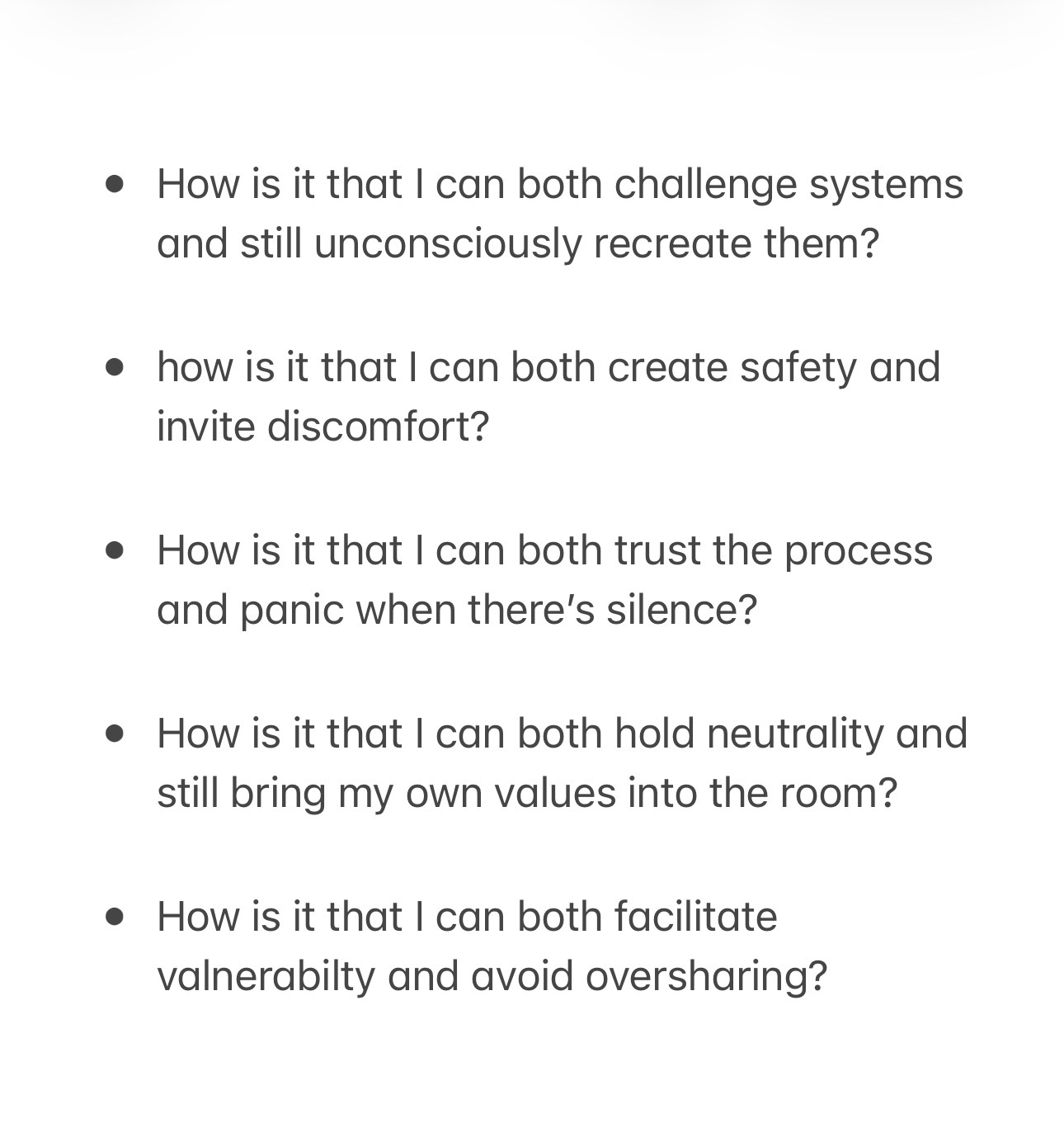
I really enjoyed this exercise. I love ambiguous things at the best of times! I love questions that don't elicit a neat answer. I love to connect seemingly unconnected things.
And that the starting point is you are not immediately trying to fix or resolve the tension. You're noticing or naming it's there. And then, naturally, you start to get curious about the why (and maybe what comes next).
With my money, finance and emotions hat on — I immediately connected how relevant this is here too. Because money stuff is absolutely full of feelings, tensions and complexities.
Money is full of wicked tensions
The usual advice about money tends to be things like tracking your spending, raising your prices, saving more, planning ahead, being disciplined, exercising self control. As if it's all just rational, logical, linear stuff. It doesn't invite questions, or get curious about what is there for you specifically - it just tells you what you're doing is probably totally wrong, and orders what you should do instead!
And yet the lived experience of money — especially for mission-led founders, business owners and creatives, who are very often in close proximity to money whilst carrying a lot of mixed feelings about it — is anything but linear. (And isn't that a wicked question in itself?)
While so many conversations about money flatten people into simplistic categories: 'disciplined' or 'disorganised', 'abundant' or 'scarcity' minded, 'good with money' or 'bad with money'. But most of us are holding competing needs, values, fears and survival strategies all at once. And often, what looks irrational from the outside makes complete sense when you understand the tension underneath it.
If you've ever listened to an episode of my podcast, The Money Story Project, you'll be well acquainted with this truth already - that money is layered. And it is because money carries the weight and depth of our experiences, education, family history, identity, culture, survival, beliefs and more. Money is entangled with worth and visibility and belonging and fear and... a great many other things. The narratives we have heard and lived through around money and meaning - they pop up consciously (or unconsciously) whenever we interact with money.
At a systemic level regardless of our own personal world, we are (mostly) also operating within patriarchal societies, under late stage capitalism and amidst rampant consumerism, and bordering on technofeudalism. Is it really any wonder we have complicated feelings about money?
I think this is also where Wicked Questions become particularly helpful with money when you are attempting to use money as a tool for good things in an imperfect world. The questions don't magically fix those tension — but they allow us to approach things with more curiosity and space for nuance.
Instead of asking: what's wrong with me? or what am I even supposed to be doing?
We begin asking: what tension am I inside? What else exists here? Have I ever considered there is this but there is also that?
And giving that some breathing space and room for creativity in how we approach what emerges from the questions. because Wicked Questions offer an invitation to understand yourself and others more fully, without the pressure to immediately change.
Providing space to notice and name what's going on, get curious about it — that's usually more effective, more stimulating, interesting and long lasting than rushing to fix a 'problem' in a way that is never going to work or feel good for you.
Wicked questions in practice
Take this wicked money question I have come up with: How is it that I can both want financial stability and resist structure?
At first glance it can sound like self-sabotage. Surely if someone wants financial stability they should naturally accept that means routines, systems, budgets, planning?
But for many people, structure doesn't simply represent safety. It may also represent control, restriction, burnout, rigidity, surveillance, pressure, or the loss of autonomy - particularly for people who for example are neurodivergent, recovering from burnout, or who grew up in environments where instability was the norm.
Sometimes people don't resist stability itself. They resist the versions of stability that once required them to abandon themselves in order to achieve it.
That is a very different thing. And understanding that distinction changes what actually helps, what they wish to lean into what greater harmony or alignment with this might feel like.
Maybe someone doesn't need more rigid structure. Maybe they need gentler systems, more autonomy, choice, flexibility in the approach routines, financial practices that support their nervous system rather than overwhelm or force it.
This insight could even change your whole strategy. But you can only get to the insight if you're willing to explore the contradiction honestly — without immediately deciding which side of it is the problem that needs to be shutdown.
In this way they also give us space for our humanness, our creativity and our rebelliousness. To say - 'actually, maybe my resistance here makes complete sense!'.
Exercise: your wicked money questions
This exercise works beautifully solo — as a journalling practice — in conversation with a trusted friend, coach, or peer, or as part of a group discussion.
If something surfaces that feels significant or tender, you might want to bring it into a supported space, like therapy or coaching, rather than sit with it alone.
Step one: come up with your own wicked money questions.
Think about your own relationship with money: What tensions do you carry? What contradictions feel alive for you right now?
Framing the contradiction as a question in this format: How is it that I can both [X] and [Y] simultaneously?
Have a go at writing your own wicked money question.
And remember a truly 'Wicked Question' only works if both sides are given equal weight and equal curiosity. This isn't "I have a good intention and a bad habit." It's "I have two real, valid but contradictory responses." That's what makes the question 'wicked'.
Here are some examples to help get you started:
- How is it that I can both think about money constantly and feel embarrassed talking about it?
- How is it that I can both want financial security and feel safer not looking at my numbers?
- How is it that I can both pour everything into my work and feel awkward about what it costs?
- How is it that I can both want financial ease and feel suspicious when things are calm?
- How is it that I can both believe in abundance and live inside a system built on scarcity?
Experiment with coming up with some wicked questions of your own (or you can work with one of my suggestions if it speaks to you!)
Step two: sit with your wicked questions
Ponder on your question(s). What does it bring up?
Some prompts if they're helpful and comfortable to work through:
- Where do you feel each contradiction in your body?
- Do they bring up any particular memories, thoughts or images?
- Which side feels more 'socially acceptable'? Which side do you tend to mask?
- Whose voice do you hear in relation to each side?
- What systems, experiences or relationships might have shaped this tension?
Step three: see where it takes you.
Let it percolate. There's no pressure to resolve or fix this contradiction— but you might find yourself wanting to explore what a resolution could look like, or talk it through with someone who is also navigating this or simply sit with it and see where you go with it over the next few days or weeks.
We're often trained — especially in financial and business contexts — to identify a problem and move immediately toward a solution. Ignoring the feelings that come up around it. The discomfort of not-knowing is something to get through quickly, on the way to an answer. But how often does this really work out for us?
Inviting in more contradiction
So much financial advice rushes straight to fixing. Telling you to just: 'Change your habits'. 'Raise your prices'. 'Track your spending'. But if we're carrying something more complex or contradictory underneath (which most of us are on account of the human experience!), then seeking to fix it without noticing what's really going on probably won't stick — or feel good.
Wicked money questions create space to honour what's actually there — the complexity, the contradiction, the feelings that don't have a clean answer. And in my experience, that's not the soft option!
I'd love to hear about your experience with wicked money questions and where they take you!
Acknowledgement:
I first encountered Wicked Questions through Ray Cooper's Holding Space series, a facilitation learning programme I'd warmly recommend. The original framework comes from Liberating Structures, developed by Henri Lipmanowicz and Keith McCandless.
More from the category:
Article
%20copy%2032.png)
%20copy%2024.png)
%20copy%203.png)
Sign up to the newsletter
Where the practical meets the visionary. Stories, tools and ideas about money, plus seasonal meanderings — straight to your inbox.